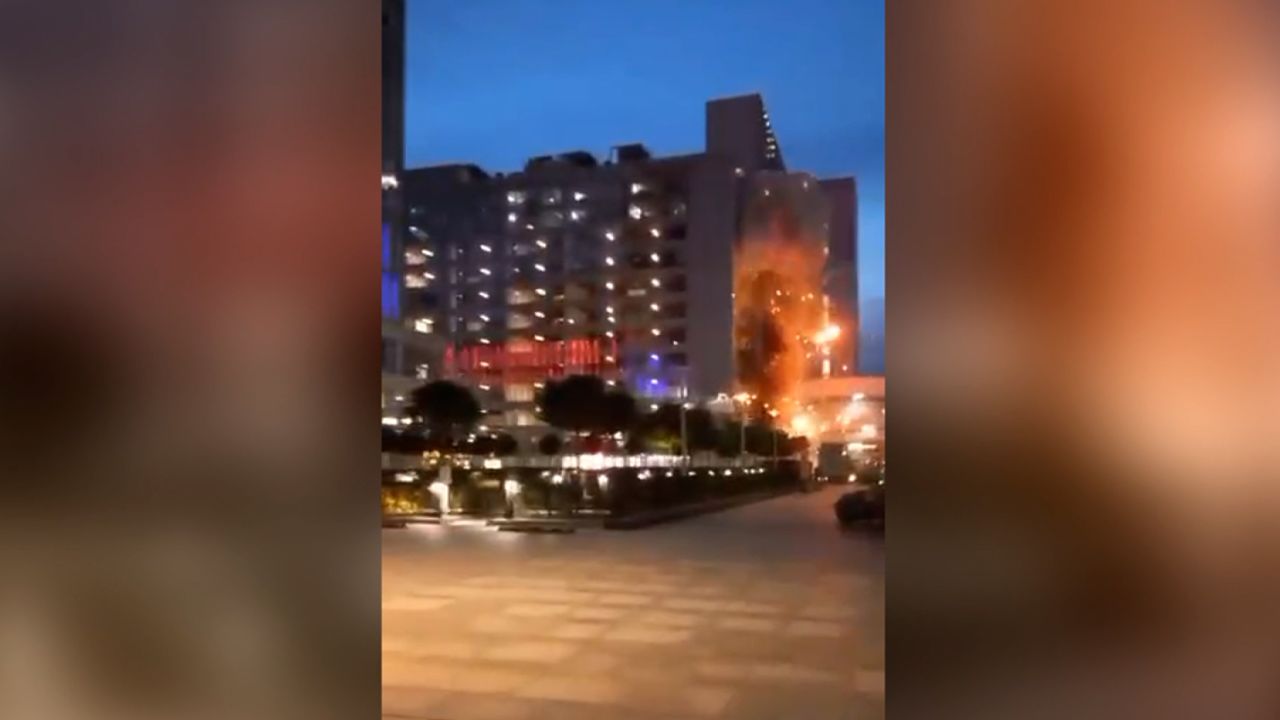
The tea in the small glass cup—the istikan—was still steaming when the percussion hit. It wasn't just a sound. It was a physical weight that pressed against the chest, rattling the windows of a thousand homes before the roar even registered in the brain. In the Jurf al-Sakhar district, south of Baghdad, the night sky didn't just brighten; it tore open.
Alina Romanowski, the United States Ambassador to Iraq, likely didn't feel that specific tremor. She lives in the fortified cocoon of the Green Zone, a place where the geography of war is often reduced to digital maps and urgent encrypted pings. But by the time the sun began to crawl over the Tigris the following morning, the tremors had reached her doorstep in the form of an official summons.
Iraq was angry. Again.
To understand why a single drone strike carries the weight of a crumbling marriage between two nations, you have to look past the sterile press releases. The "heinous" strike, as the Iraqi government labeled it, killed several members of the Popular Mobilization Forces (PMF). To Washington, these targets are Iranian-backed proxies, the shadowy hand of Tehran reaching across the border to harrying American troops. To Baghdad, they are part of the national security fabric, state-sanctioned paramilitaries who helped break the back of ISIS.
This is the impossible tightrope of Iraqi sovereignty.
The Ghost in the Room
Imagine standing in your own living room while two neighbors settle a blood feud across your coffee table. You didn't invite the fight, but you’re the one who has to replace the broken lamps and scrub the blood out of the carpet.
For years, Iraq has served as the unwilling arena for the "shadow war" between the United States and Iran. Every time a rocket is fired at an American base, the U.S. feels a binary need to retaliate. Strength must be met with strength. Deterrence is the word of the day in the Pentagon. But in the halls of the Iraqi Prime Minister’s office, that "deterrence" looks a lot like a violation of the lease.
Prime Minister Mohammed Shia al-Sudani finds himself in a corner. He is a man trying to fix power grids, stabilize a currency, and keep the young, restless population from taking to the streets again. He needs the U.S. for banking stability and military training. He needs Iran for natural gas and political peace.
When the U.S. strikes without his permission, it makes him look like a spectator in his own country.
The summons of Romanowski wasn't just a diplomatic formality. It was a scream for agency. The Iraqi Foreign Ministry’s statement didn't mince words, calling the strike a "clear violation of the mission" for which the international coalition is present on Iraqi soil. That mission is supposed to be about advice and assistance, not unilateral executions on the outskirts of the capital.
The Math of Retaliation
Numbers rarely tell the whole story, but they provide the rhythm. Since October 2023, the tempo of violence has accelerated like a heartbeat in a panic attack. Drone swarms, rocket volleys, and precision airstrikes have become the new weather pattern.
The U.S. maintains roughly 2,500 troops in Iraq. They are there to ensure ISIS—a monster currently sleeping but very much alive—doesn't find the strength to stand back up. However, the presence of those troops acts as a lightning rod. Local militias, grouped under the umbrella of the Islamic Resistance in Iraq, view the Americans not as protectors, but as occupiers.
Consider the mechanics of the Jurf al-Sakhar strike.
It wasn't a stray bomb. It was a calculated, surgical removal of "imminent threats." But "imminent" is a subjective word in a war zone. When the smoke cleared, the casualties were Iraqi citizens wearing Iraqi uniforms, regardless of where their true loyalties lay.
When a sovereign nation’s soldiers are killed by their "partners" without a phone call or a "by your leave," the partnership begins to feel like a hostage situation.
The Invisible Stakes
If this were just about a few drones, the world might look away. But the stakes are buried much deeper, in the very plumbing of the global economy and regional stability.
If the Iraqi government is forced by public and political pressure to expel U.S. forces, the vacuum won't remain empty for long. History is a cruel teacher in this region. We saw the vacuum of 2011 lead to the black flags of 2014.
The fear isn't just a return of radical extremists. It’s the total collapse of the delicate balance that keeps Baghdad from becoming a total satellite of Tehran. If the U.S. is kicked out in a fit of rage over "heinous" strikes, the bridge between Iraq and the Western financial system might just collapse with it.
Yet, how much can a nation endure?
Imagine a hypothetical shopkeeper in Hillah, just down the road from the strike. He doesn't care about the geopolitical chess match. He cares that the vibrations from the explosions cracked the plaster in his ceiling. He cares that his children asked if the "bad men" were coming back. To him, the distinction between a "defensive strike" and an "act of aggression" is a luxury for people who don't have to live in the blast radius.
The Language of the Summons
When a diplomat is summoned, the room is usually cold. The air conditioning hums, the water is served in heavy crystal, and the words are chosen like landmines.
The Iraqi officials handed Romanowski a protest note. It is a piece of paper that carries the weight of a thousand years of pride. Iraq is not a new country; it is a cradle of civilization that has been trampled by empires for decades. There is a profound, aching desire among its people to simply be left alone to rebuild.
The strike in Jurf al-Sakhar felt, to the Iraqis, like a dismissal of that pride. It signaled that despite the meetings, the handshakes, and the billions of dollars in aid, the U.S. still views Iraqi soil as a convenient firing range.
Washington’s counter-argument is predictable: "Stop the militias from attacking us, and we won't have to strike back."
It sounds logical in a briefing room in Virginia. It sounds impossible in a parliament in Baghdad where those very militias hold seats, command budgets, and control entire neighborhoods. The Prime Minister cannot simply turn them off like a light switch. They are the light switch.
The Cost of a Miscalculation
We often talk about war in terms of "assets" and "targets." We forget the exhaustion.
The Iraqi people are exhausted. They have lived through the Iran-Iraq war, the invasion of Kuwait, the sanctions of the nineties, the 2003 invasion, the sectarian bloodletting, and the rise and fall of the Caliphate. They are a people who just want the istikan of tea to stay still on the table.
Every time a "precision strike" occurs, that peace is deferred.
The U.S. argues that these strikes save lives by preventing future attacks on their personnel. And they are likely right in the short term. But the long-term cost is the erosion of the only pro-Western outpost in a very hostile neighborhood.
What happens when the "heinous" strikes become the only thing the public remembers?
The relationship is currently held together by duct tape and shared necessity. The U.S. needs the base; Iraq needs the dollar. But money and geography are poor substitutes for trust. Trust died somewhere in the fire and twisted metal of the last drone strike.
The Night After
The sun sets over Baghdad, casting long, orange shadows across the concrete T-walls that still mar the city’s beauty. The traffic is a chaotic symphony of horns and exhaust. On the surface, life goes on.
But in the corridors of power, the calculus has changed.
The summons of the U.S. envoy is a warning shot. It is a signal that the "hospitality" of the Iraqi state is reaching its limit. If the strikes continue, the Iraqi government may find it more politically expensive to keep the Americans than to let them go, regardless of the consequences.
The tea has gone cold. The window has been patched with plastic sheeting. The sky is dark again, and everyone is listening to the silence, wondering if it will stay that way.
The real tragedy of Jurf al-Sakhar isn't just the fire that burned that night. It’s the realization that in the game of giants, the ground underneath always gets crushed. And eventually, the ground stops welcoming the giants.
The silence in Baghdad tonight isn't peace. It’s a breath held in anticipation. In the distance, the low hum of a propeller might be a commercial flight, or it might be the next spark in a powder keg. For the man in the street, the difference is everything. For the commanders in the bunkers, it’s just another Tuesday.
The glass is broken. The question is whether anyone has the stomach to pick up the pieces before someone else starts bleeding.
Would you like me to analyze the historical parallels between this incident and the 2020 strikes that led to the previous expulsion vote in the Iraqi Parliament?