The headlines are vibrating with the kind of armchair generalship that usually precedes a decade-long quagmire. Recent reports suggest the Trump administration is "weighing" a surgical raid on Iranian soil to "extract" enriched uranium. It sounds like a Hollywood script: Delta Force slides down ropes, grabs some glowing canisters, and flies into the sunset while the centrifuges spin aimlessly behind them.
It is a fantasy. It is technically illiterate. It is a fundamental misunderstanding of how nuclear physics and industrial-scale chemistry actually function. Meanwhile, you can explore other events here: The Calculated Silence Behind the June Strikes on Iran.
If you think you can "extract" a nation's nuclear program with a few helicopters and a dream, you don't understand the difference between a jewelry heist and a hazardous materials remediation project. This isn't about political will or military "bravery." It is about the stubborn, inconvenient reality of isotopes and massive industrial footprints.
The Logistics of a Suicide Mission
Most people hear "enriched uranium" and think of a few suitcases worth of material. They imagine a high-value asset that fits in a lead-lined box. To see the full picture, we recommend the recent report by BBC News.
The reality? Iran’s enriched uranium isn't sitting in a neat pile waiting for a pickup. It exists largely as uranium hexafluoride ($UF_6$).
At room temperature, $UF_6$ is a volatile crystalline solid, but in the enrichment cycle, it’s a gas. It’s highly corrosive. It reacts violently with water. If you crack a cylinder during a firefight, you aren't just dealing with radiation; you are dealing with a chemical cloud that turns into hydrofluoric acid the moment it touches the moisture in your lungs.
To "extract" this material, you aren't just grabbing a bag. You are moving multi-ton steel cylinders. You need heavy lift cranes. You need specialized transport vehicles. You need a secure perimeter that holds for days, not minutes.
I have watched logistics officers struggle to move standard shipping containers in a "secured" port in Kuwait. Trying to do it under fire in the middle of a mountain-side facility like Fordow or Natanz is a logistical hallucination.
The Fordow Problem: Physics vs. Special Forces
The "lazy consensus" in the media assumes that because we have "bunker busters," we have access. This ignores the physical reality of the Iranian enrichment architecture.
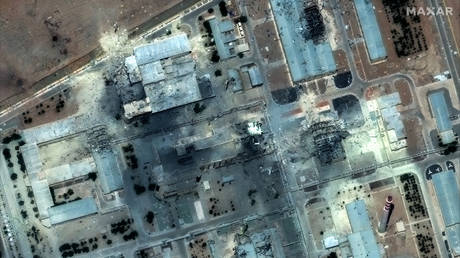
Fordow is buried under roughly 80 to 90 meters of rock and soil. It was designed specifically to survive the exact "raid" the WSJ is currently theorizing. You cannot "raid" a facility that is essentially a fortified tunnel system deep inside a mountain unless you plan on occupying the entire province.
- The Entry Problem: There are limited access points. They are heavily defended.
- The Removal Problem: Even if you clear the tunnels, how do you get the material out? You can't fast-rope 2,000kg of $UF_6$ up a 300-foot shaft.
- The Contamination Problem: One stray bullet into a centrifuge cascade releases a toxic, radioactive mess that makes the facility a deathtrap for the very soldiers sent to "extract" the prize.
Why "Extraction" is the Wrong Goal
If the goal is to stop a bomb, "extraction" is the most inefficient path imaginable. It is the tactical equivalent of trying to vacuum a carpet while the house is on fire.
The focus on the material misses the machinery. Iran’s real nuclear power isn't the stockpile; it’s the knowledge and the centrifuge manufacturing capacity. You can take the gas, but as long as the IR-6 and IR-9 centrifuges are being manufactured in nondisclosed workshops across the country, they can simply replace the stockpile.
We are obsessed with the "stuff" because it’s easy to visualize. We should be terrified of the "process" because it’s impossible to steal.
The Dirty Truth About "Surgical" Strikes
Military planners love the word "surgical." It implies precision, minimal bleeding, and a quick recovery. In the context of a nuclear facility, there is no such thing as surgery. There is only blunt-force trauma.
Imagine a scenario where a raid team actually reaches the storage hall. They find 1,200kg of uranium enriched to 60%.
$$U^{235} \text{ enrichment levels are not binary.}$$
The amount of work required to move from 60% to 90% (weapons grade) is mathematically much smaller than the work required to get from 0.7% (natural) to 4%. Iran has already done the heavy lifting.
Taking that material involves a "chain of custody" that would be a nightmare. You are flying slow, heavy transport birds over some of the most sophisticated air defense networks in the region. You aren't just risking the soldiers; you are risking the accidental dispersal of 60% enriched uranium over a civilian population center if a transport plane is downed.
The Intelligence Gap: What We Don't Know
The media treats the IAEA reports as a complete map of the Iranian nuclear soul. It isn't.
I've spent years analyzing supply chains for sensitive technologies. The biggest mistake we make is assuming the target is where we are looking. If you raid Natanz, you are betting everything that Iran hasn't already moved a significant portion of its "breakout" capacity to a "black" site we haven't identified yet.
A raid on a known site might actually accelerate a move toward a weapon. Once the "known" assets are seized or destroyed, the Iranian leadership has every incentive to go fully underground with whatever remains.
The Economic Delusion
There is a segment of the "insider" community that believes a raid would be a "cheap" way to reset the clock. They argue it avoids a full-scale war while removing the immediate threat.
This is a failure of basic game theory.
- Market Shock: The moment boots hit the ground at a nuclear site, oil hits $150 a barrel.
- Retaliation: Iran doesn't have to win the fight at the facility. They just have to close the Strait of Hormuz.
- The Cost of Failure: If the raid fails—if a helicopter goes down, or the material isn't where the intel said it was—the United States loses its deterrent power overnight.
Stop Asking if We Can, Ask if It Matters
The question "Can we raid Iran for uranium?" is a distraction. The answer is "Technically, perhaps, but practically, no."
The better question is: "What happens the day after?"
If you take the uranium, you’ve declared war. If you’ve declared war, why are you messing around with a "raid" to steal gas? You’re either in a total conflict to dismantle the regime, or you’re performing a dangerous, high-stakes piece of theater that ends with more radiation in the atmosphere and more centrifuges in the ground.
Extraction is a myth sold by people who see the world through a tactical lens but ignore the laws of physics and the brutal reality of industrial chemistry. You don't "extract" a nuclear program. You either negotiate it away, or you bury it under a mountain of rubble and hope the dust doesn't blow back toward you.
Anyone telling you there’s a third option involving a "surgical" extraction is lying to you or themselves.
The canisters stay where they are. Either they are monitored, or they are bombed. There is no middle ground where we fly them home.