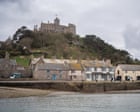
The Atlantic doesn't care about your local history. It doesn't care about the century-old stones of the St Michael’s Mount causeway or the fragile cliffs of Porthleven. When Storm Goretti tore through Cornwall this week, it wasn't just another rainy Tuesday. It was a violent reminder that our most cherished landmarks are essentially sitting ducks. You’ve seen the photos of the debris. You’ve heard the locals describe the scene as "traumatic." They’re right to be shaken. We’re watching the slow-motion erasure of the Cornish coastline, and honestly, we aren't moving fast enough to stop it.
Storm Goretti hit with a ferocity that caught even the seasoned weather-watchers off guard. While the Met Office issued the standard warnings, the reality on the ground was a different beast. Sustained winds over 80mph met a high spring tide in a way that felt like a coordinated assault on the shore. If you were standing on the Penzance promenade, you weren't just seeing waves; you were seeing the weight of the ocean trying to reclaim the land.
Why Storm Goretti Was Different for Cornwall
Most storms pass. They break a few umbrellas and move on. Goretti lingered. It stayed just long enough to saturate the cliffs and then battered them with a relentless swell. The damage at St Michael’s Mount isn't just a bit of loose gravel. The causeway, that iconic walk-way used by thousands of tourists and pilgrims, took a beating that has locals wondering about its long-term stability.
When people say it’s "traumatic," they aren't being dramatic. For those whose livelihoods depend on these landmarks, a storm like this is a direct threat to their survival. You can’t just "fix" a granite pier that’s been shifted six inches by the sheer power of water. It’s a structural nightmare. It’s expensive. And frankly, it’s heartbreaking to see places that have stood for hundreds of years get dismantled in a single night.
The True Cost of Heritage Repair
Repairing these sites isn't like fixing a pothole in a supermarket parking lot. You’re dealing with Heritage England, specific building materials that have to be sourced from specific quarries, and craftsmen who actually know how to work with dry-stone techniques. The bill for Storm Goretti is going to be astronomical.
We often talk about the economic impact of tourism in Cornwall. It’s the lifeblood of the county. But when the "product" you’re selling is the scenery and the history, what happens when the scenery starts falling into the sea? We're looking at a situation where the cost of maintenance might soon outweigh the revenue these sites bring in. That’s a conversation nobody wants to have, but it’s the one we need.
The Misconception of Sea Defences
A lot of people think we can just build bigger walls. We can’t. Physics wins every time. If you build a massive concrete sea wall, the energy of the wave doesn't just disappear. It gets redirected. Often, it gets pushed down or to the sides, scouring the sand away from the base of the wall until the whole thing collapses anyway.
We saw this play out in several spots across the north coast during Goretti. The areas with "hard" defences often fared worse than the natural dunes because the water had nowhere to go. It just pounded the same spot until something gave way. In Bude and Newquay, the sheer volume of water overtopping the walls turned streets into rivers. It’s a losing game.
What the Experts Are Seeing
Coastal engineers have been sounding the alarm for years. The University of Exeter has published data showing that the rate of coastal erosion in the Southwest has accelerated significantly over the last two decades. Storm Goretti is a data point on a very steep, very scary curve.
I’ve talked to people who have lived in Marazion for fifty years. They tell me the same thing. The sea is coming higher, and it’s staying longer. The "once in a lifetime" storms are happening every three years. If you don't think that's a problem, you aren't paying attention.
The Emotional Weight of a Battered Coast
Cornwall isn't just a place on a map. It’s an identity. When you see a landmark like the Minnack Theatre or the harbour walls at Mullion Cove getting hammered, it feels personal. It’s where people got married. It’s where they scattered ashes. It’s where they took their kids for ice cream.
The trauma comes from the realization that these places aren't permanent. We’ve grown up with the idea that the "rugged Cornish coast" is invincible. It’s not. It’s fragile. The granite might be hard, but the land it sits on is being eaten away.
Moving Beyond the Clean Up
Right now, the focus is on the cleanup. Volunteers are out with shovels. The National Trust is assessing the damage. This is the part we’re good at—the community coming together to pick up the pieces. But we need to be better at the "before" part.
We need to stop treating these storms as surprises. They are the new baseline.
Real Steps for Coastal Preservation
We have to stop rebuilding exactly the way things were. That’s a trap. If a wall failed during Storm Goretti, building the same wall in the same spot is just waiting for the next storm to do it again.
- Strategic Realignment. This is the term experts use for "moving back." It’s painful. It means giving up some land to save the rest. It’s a hard sell for a business owner on the water's edge, but it’s often the only realistic option.
- Natural Buffers. We need more kelp forests and offshore reefs. These don't stop the waves, but they drain the energy out of them before they hit the shore. It’s a softer, smarter way to defend the coast.
- Dedicated Funding. The current system of "emergency grants" after a disaster is reactive and inefficient. We need a permanent, well-funded coastal heritage trust that can perform preventative maintenance year-round.
The images of the debris from Storm Goretti will eventually fade from the news cycle. The causeway will be cleared. The shops will reopen. But the sea isn't going anywhere. It’s waiting for the next low-pressure system to roll in from the Atlantic. We can’t say we weren't warned.
If you want to help, don't just post a "sad" emoji on a photo of a broken pier. Support the organizations that are actually doing the hard, unglamorous work of coastal management. Buy a membership to the National Trust. Volunteer for a beach clean. Demand that local councils prioritize sea defences that actually work with nature instead of fighting it.
Start looking at the coastline differently. Don't take it for granted. Every time you walk on a beach or stand on a cliff, realize you’re standing on the front line of a war we’re currently losing. The trauma of Storm Goretti should be the wake-up call that finally gets us moving.