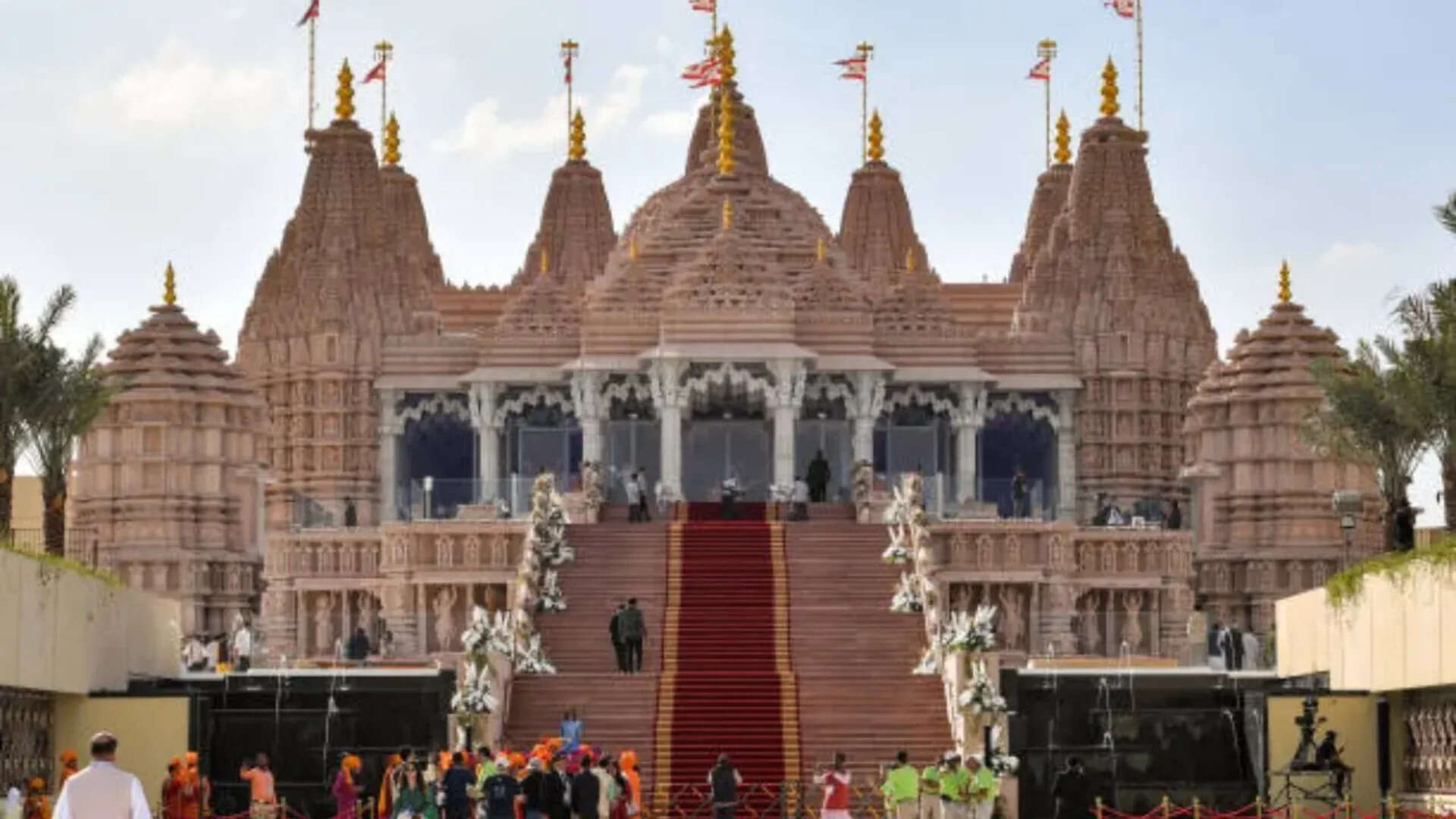
The desert is never truly silent. If you stand still enough in the dunes of Abu Dhabi, the wind carries the shifting grit of the Empty Quarter, a dry, persistent hiss. But lately, just off the highway connecting the capital to Dubai, a different sound has defined the horizon. It is the rhythmic, metallic tink-tink-tink of hammers meeting pink sandstone. It is the sound of five thousand years of Indian craftsmanship breathing life into the Arabian sand.
For a few weeks, that music stopped.
The gates of the BAPS Hindu Mandir swung shut. To the casual observer, it was a "temporary closure for maintenance and logistical adjustments." To those who had spent years watching seven spires rise like a mirage from the scrubland, the silence was heavy. A temple is not just a building; it is a living entity. When the doors close, the heartbeat of a community skips a beat.
Now, the rhythm returns. On April 14, the stone will speak again.
The Weight of a Single Grain
Imagine a stonemason named Amit. He is hypothetical, but his hands represent the twenty thousand tons of stone shipped from Rajasthan. Amit spends his days touching surfaces that feel like frozen silk. He knows that the pink sandstone he carves is porous, ancient, and sensitive. It traveled thousands of miles across the sea to sit under a sun that reaches temperatures capable of melting asphalt.
When the temple closed its doors shortly after its historic inauguration, whispers moved through the crowds. Was something wrong? Was the heat too much? The reality is far more human. The Mandir became a victim of its own beauty. Thousands upon thousands of people descended upon the site, their shoes treading on floors designed for sacred quiet, their breath humidifying halls meant for the dry preservation of art.
The closure wasn't about failure. It was about reverence.
The authorities needed a moment to breathe. They needed to ensure that the delicate carvings of camels, elephants, and lions—symbols of a cultural bridge between the Ganges and the Arabian Gulf—would not be eroded by the sheer force of human enthusiasm. They were fine-tuning the choreography of the crowds.
Why the Date Matters
April 14 is not a random selection pulled from a calendar. It is a day of profound renewal. Across India, this date marks the beginning of the traditional New Year in various forms—Vaisakhi, Vishu, Poila Baisakh. It is the moment the harvest is celebrated, a time when the old is swept away to make room for the blooming current.
By reopening on this specific Sunday, the temple isn't just opening its doors; it is resetting its soul.
For the expatriate worker who hasn't seen his family in Kerala for two years, this reopening is a homecoming. For the Emirati official who helped facilitate the land grant, it is a testament to a promise kept. The "logistical adjustments" mentioned in press releases are actually the invisible threads of safety and respect being woven tighter. New pathways have been laid. Security protocols have been polished. The flow of humanity has been mapped out like a river, ensuring that when the gates open, the experience is one of peace rather than a crush of bodies.
The Invisible Stakes
We often treat landmarks as static objects. We take a photo, we post it, we move on. But the BAPS Hindu Mandir represents a fragile, beautiful experiment in coexistence. In a world that seems increasingly intent on building walls, this structure was built with 1.8 million bricks and zero steel reinforcement. It relies on the physics of gravity and the chemistry of ancient architectural wisdom.
If the "logistics" aren't perfect, the sanctity is lost.
The closure allowed the volunteers—thousands of them, working for free—to scrub the floors with the devotion usually reserved for a child's face. They adjusted the lighting to better catch the translucent glow of the white Italian marble used in the interior. They ensured that the "Ganga" and "Yamuna" rivers—symbolic water features flowing around the temple—were pristine.
Consider the logistical nightmare of managing a site that is both a tourist magnet and a house of God. You have to balance the curiosity of a traveler from London with the piety of a grandmother from Gujarat. You have to ensure that the heat of the UAE afternoon doesn't turn a spiritual pilgrimage into an endurance test.
The reopening is the answer to those challenges. It is the "Version 2.0" of a spiritual landmark.
A Walk Through the Reborn Gates
When you pass through the entrance this Sunday, the first thing you will notice is the temperature. Not just the physical cooling of the shaded corridors, but the drop in the frantic energy of the outside world. The highway noise fades. The shimmer of the heat haze is replaced by the solid, grounding presence of the pillars.
There are 200 of them. Each one tells a story. Some depict scenes from the Ramayana; others show the intricate patterns of Emirati weaving. This is the "logic" that the closure sought to protect. You cannot rush past these stories. You cannot view them through the lens of a crowded lobby.
The new visitor management system is designed to give you back your eyes. By controlling the numbers, the temple authorities are gifting each visitor a moment of solitude. They are ensuring that when you look up at the seven shikhars—representing the seven Emirates—you aren't looking over someone’s shoulder.
The Silence and the Song
The reopening of the BAPS Hindu Mandir is a reminder that excellence requires pauses. In our world of "always-on" and "immediate access," we find it frustrating when a door is locked. We want what we want, and we want it now. But the desert teaches a different lesson. It teaches that the most significant things take time to settle.
The stone needs to settle. The community needs to prepare. The air needs to clear.
As the sun sets over Abu Dhabi on April 14, the pink sandstone will catch the orange light and glow as if it were lit from within. The hammers have done their work. The planners have finished their spreadsheets. The volunteers have straightened their uniforms.
The gates are heavy, made of wood and history, but they move with a lightness that defies their mass. Behind them lies a space where the sand of Arabia and the spirit of India have finally stopped competing and started a conversation.
Step inside. Listen. The stone is speaking again.


