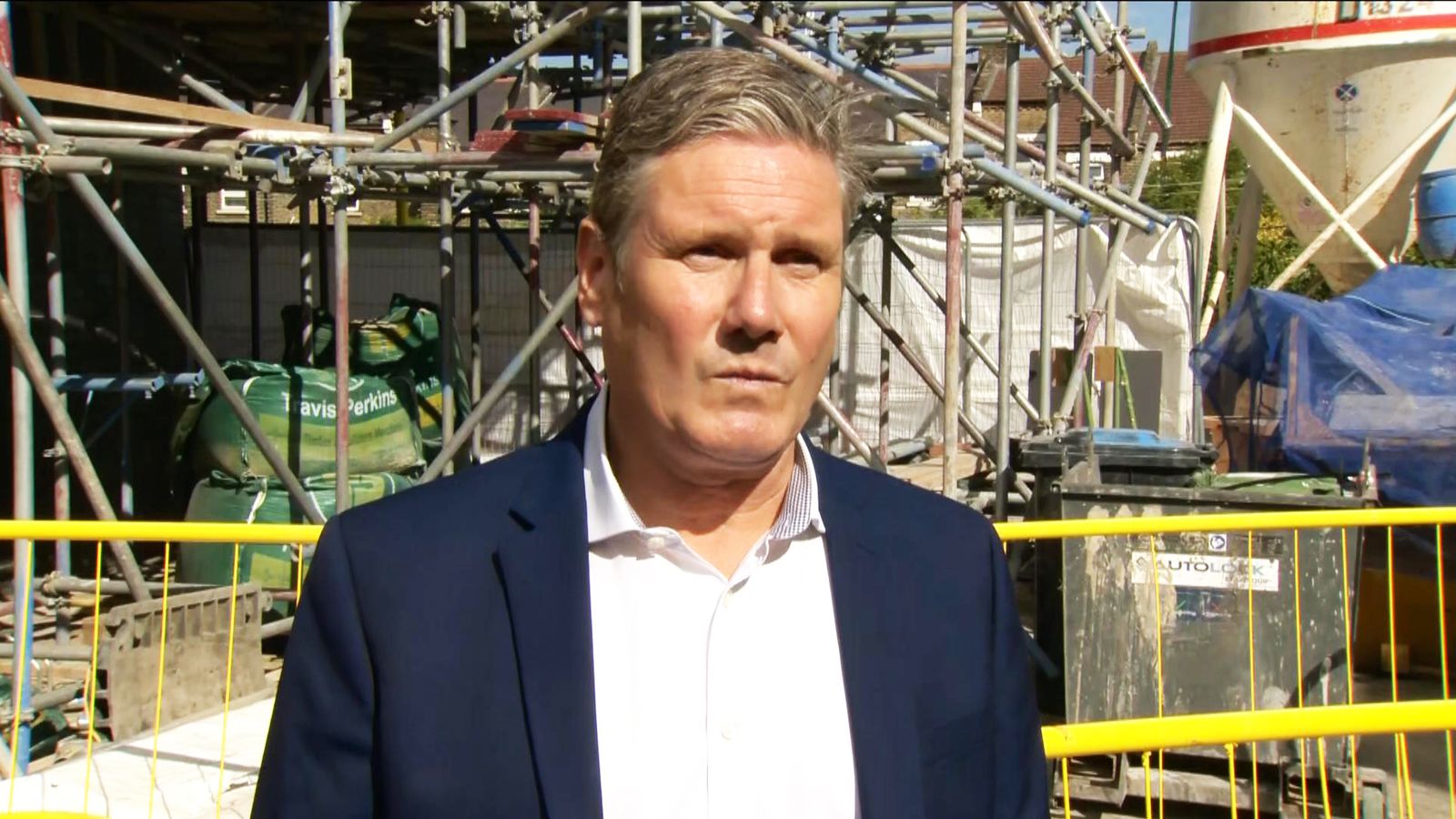
Keir Starmer is "fed up." He’s tired of Vladimir Putin and Donald Trump dictating the price of a cup of tea in Manchester. It’s a convenient narrative. It’s also a total abdication of domestic responsibility. By blaming the "global energy rollercoaster," the Prime Minister is performing a classic sleight of hand. He wants you to look at the Kremlin so you don't look at the National Grid.
The uncomfortable truth? British energy prices aren't high because of foreign autocrats. They are high because of decades of systemic cowardice in Westminster. We have built a fragile, weather-dependent system that lacks the one thing a modern economy needs to survive: redundancy. If your national security depends on the price of liquefied natural gas (LNG) in a global spot market, you haven't been "hit by a crisis." You’ve built a house out of straw and are now complaining that the wind is blowing. Building on this theme, you can find more in: Strait of Hormuz and the Brutal Truth About the Million Dollar Toll.
The Myth of Global Victimhood
The "lazy consensus" pushed by the current administration suggests the UK is a helpless cork bobbing on the ocean of international commodity markets. This is nonsense.
Look at the data. The UK has some of the lowest natural gas storage capacity in Europe. While nations like Germany or Italy can store roughly 25% to 33% of their annual consumption, the UK’s capacity has historically hovered around 1% to 2%. When the Rough storage facility was closed in 2017, we didn't just lose a site; we lost our shock absorber. Observers at Harvard Business Review have also weighed in on this trend.
When Putin throttled the pipelines, Europe felt the squeeze, but the UK felt the punch because we had no buffer. Starmer’s frustration with Putin is like a driver blaming the rain for a skid when they’ve been driving on bald tires for five years.
Why Renewables Aren't the Instant Fix
The government’s obsession with "Clean Energy by 2030" is being sold as the ultimate shield against Trump’s tariffs or Putin’s whims. It won’t be. Not under the current architecture.
Wind and solar are fantastic when the sun shines and the breeze blows. But they suffer from intermittency. In the energy world, we talk about the "Dunkelflaute"—the dark doldrums. These are periods of high pressure where wind speeds drop across the entire continent for days or weeks.
During these periods, the marginal price of electricity is set by whatever gas plant is forced to fire up to keep the lights on. Because of the UK's "marginal pricing" system, even if 90% of your power comes from cheap wind, if that last 1% comes from expensive gas, the entire market pays the gas price.
Starmer isn't fixing this mechanism. He’s just doubling down on the generation side without addressing the pricing floor or the storage deficit.
The Trump Tariff Panic is a Distraction
There is a growing fear in Whitehall that a second Trump term—and his promised 10% to 20% across-the-board tariffs—will ignite a global trade war that spikes energy costs.
Let’s dismantle this. Trump is a "drill, baby, drill" advocate. His stated goal is to flood the market with US hydrocarbons to lower domestic costs. In a globalized market, increased US production generally puts downward pressure on Brent Crude and Henry Hub gas prices.
The real threat isn't Trump’s trade policy; it’s the UK’s inability to capitalize on a shifting energy map. We are so terrified of "relying on the US" or "relying on the Middle East" that we are paralyzing our own North Sea production.
I’ve sat in rooms with energy executives who are ready to pour billions into the North Sea transition. They aren't asking for subsidies. They are asking for fiscal stability. Instead, they get windfall taxes that change every six months. You cannot plan a thirty-year infrastructure project on a six-month political whim.
The Nuclear Elephant in the Room
If Starmer truly wanted to decouple the UK from the "global rollercoaster," he would be talking about baseload power. Real baseload.
Nuclear energy is the only technology currently capable of providing carbon-free, massive-scale power regardless of the weather or the geopolitical climate. Yet, the UK’s nuclear fleet is aging out. Hinkley Point C is a bureaucratic nightmare of delays. Sizewell C is still a series of powerpoints and legal challenges.
Instead of a "War Rooms" style approach to nuclear, we get more talk about "Great British Energy"—a state-owned company that, so far, looks more like a branding exercise than a utility provider.
The Actionable Pivot: What We Actually Need
Stop asking "How can we stop Putin from raising prices?" and start asking "How can we make Putin’s actions irrelevant?"
- End Marginal Pricing Now: We need a "split market." Energy generated by renewables and nuclear—which have high capital costs but near-zero fuel costs—should be decoupled from the price of gas. Consumers should pay a weighted average, not the highest marginal cost.
- Industrial-Scale Storage: We don't just need batteries for 4 hours; we need hydrogen and pumped hydro for 4 weeks. This is the only way to survive a Dunkelflaute without begging Qatar for a tanker.
- Regulatory Clearance: It currently takes longer to get a grid connection for a wind farm than it took to fight World War II. This is a choice.
The Cost of Complacency
The "I'm fed up" rhetoric is a shield for a lack of ambition. It’s easier to point at a villain in a far-off land than it is to take on the NIMBYs blocking transmission lines in the East of England or the Treasury officials who view energy storage as a "cost" rather than an investment.
High energy prices are a tax on everything. They kill manufacturing. They freeze the elderly. They stifle innovation. If the UK continues to outsource its energy security to the "global market" while refusing to build its own fortress, we deserve exactly what we get.
Being "fed up" isn't a policy. It’s a tantrum.
Build the storage. Reform the pricing. Fire up the reactors. Or stop complaining when the rest of the world refuses to subsidize your stagnation.