The air in Henan province doesn’t just sit; it clings. It carries the scent of coal smoke, damp earth, and the metallic tang of heavy industry. For most people, this is the backdrop of a mundane life. For Zuo Yerong, it was the atmosphere of a tomb.
He is ninety years old. At that age, the world generally expects a man to shrink. To occupy a smaller chair, to speak in shorter sentences, and eventually, to fade into the wallpaper of a nursing home or a quiet spare bedroom. But Zuo Yerong found that when you lose everything, the walls of a house don't offer comfort. They offer an echo.
Silence is a heavy thing. It has a physical weight that presses against the chest. When his wife died, the silence was manageable; they had lived a long, full life together. But then came the unthinkable. The biological clock of his family didn't just stop; it was smashed. His son, his daughter-in-law, and finally, his grandson—the one meant to carry the name into the future—were all gone.
Imagine standing in a kitchen where four sets of footsteps used to shuffle, and now there is only the sound of your own breath. It is a mathematical cruelty.
The Geometry of Grief
Most people treat grief like a wound that needs to be covered. They stay still. They wait for the "healing" that the greeting cards promise. But Zuo Yerong understood something visceral: if he stayed still, the grief would settle into his joints like rust. He didn't need a therapist or a prescription. He needed a horizon.
He bought a bicycle.
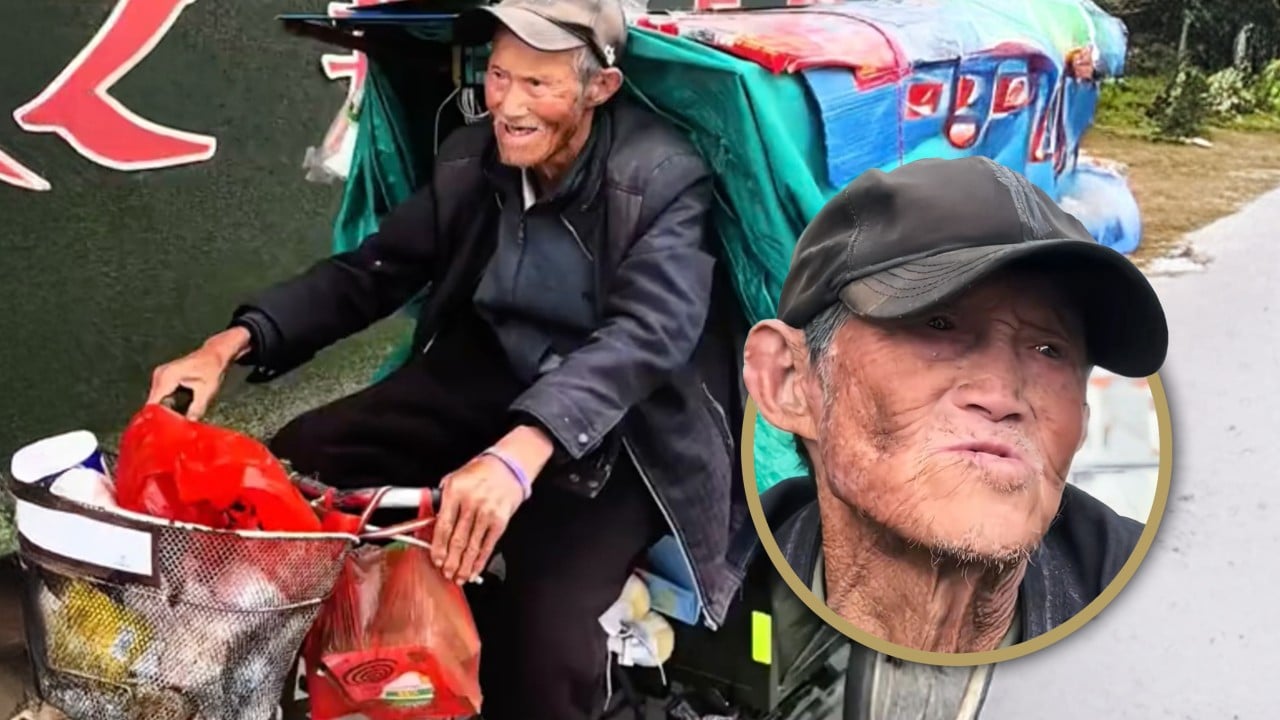
It wasn’t a high-end carbon fiber machine. There were no aerodynamic frames or electronic gear-shifters. It was a sturdy, heavy, utilitarian thing—the kind of bike that looks like it was forged rather than manufactured. To a ninety-year-old man, a bicycle is not a hobby. It is a defiance of physics.
Every morning, he would strap a small pack to the rear rack. Inside were the basics: some water, a bit of food, and the heavy, invisible cargo of his memories. Then, he would push off.
The first few miles are always the hardest. The knees protest. The lungs, weathered by nine decades of breathing, struggle to find a rhythm. But then, the momentum takes over. There is a specific magic in the centrifugal force of two spinning wheels. It creates a temporary stability that doesn't exist when you’re standing still.
The Long Road to Nowhere in Particular
He didn't have a map with a red "X" marking a destination. His goal was simpler: to keep the wind in his face until the noise in his head went quiet.
China is a vast, contradictory landscape. He pedaled through the neon-soaked fringes of rising megacities and the crumbling, dusty alleyways of villages that time had forgotten. He saw the "economic miracle" from the saddle of a bike moving at twelve miles per hour. People stared. How could they not? A man whose skin resembled parchment, legs like knotted oak, pedaling through the rain, the heat, and the exhaust.
Some stopped him to offer food. Others, suspicious or confused, asked him why he wasn't at home resting.
"If I rest," he would tell them, his voice raspy but firm, "the ghosts catch up."
It is a biological reality that exercise releases endorphins, but for Zuo, the chemistry was more complex. It was about the externalization of internal pain. Every hill climbed was a physical manifestation of the uphill struggle to wake up every morning without his grandson's voice in the house. The burn in his quads was a distraction from the ache in his heart. It was a fair trade.
The Science of Moving On
We often talk about "moving on" as a metaphor. We tell the bereaved to move on with their lives, to move on to the next chapter. We rarely mean it literally.
However, there is a profound psychological shift that occurs when a person moves through space. It’s called "optic flow." As objects move past your field of vision—trees, signposts, clouds—it sends a signal to the brain that time is passing and the environment is changing. It desensitizes the amygdala. It lowers the stress response. For a man who had lost his entire lineage, optic flow was the only thing keeping his mind from collapsing into a black hole of "what ifs."
Zuo Yerong wasn't just cycling across China; he was cycling through the stages of a grief that should have killed him.
He slept in cheap roadside guesthouses. He ate simple bowls of noodles. He fixed his own flats, his trembling hands becoming steady when faced with a mechanical problem he could actually solve. You can’t fix a dead grandson. You can fix a punctured tire. There is a quiet, desperate dignity in that.
The Invisible Stakes
Why does a story about a ninety-year-old cyclist matter to someone sitting in an office in London or a suburb in Ohio?
Because we are all terrified of the silence. We live in an era of unprecedented connectivity, yet we are haunted by the fear that we will eventually end up alone, our stories unread, our lives reduced to a few frames on a mantelpiece. Zuo Yerong is the extreme version of our greatest fear. He represents the absolute zero of social isolation.
And yet, he is moving.
His journey challenges the modern obsession with "safety" and "retirement." We are told that the goal of old age is to minimize risk. Don't climb that. Don't go there. Stay inside where the floor is level and the temperature is controlled. We treat the elderly like fragile porcelain, forgetting that porcelain is only created through intense heat.
By refusing to stay put, Zuo redefined what it means to be a survivor. Survival isn't just the absence of death. It is the active pursuit of the next mile.
The Logistics of a Miracle
The numbers are staggering. Over 6,000 miles. Provinces crossed like tally marks on a prison wall.
He didn't have a support van. He didn't have a sponsorship deal with a sportswear brand. He had a hat to keep the sun off his neck and a resolve that could grind mountains into dust. When the rain turned the roads into slick ribbons of danger, he didn't call for a taxi. He waited under a bridge, watched the water fall, and thought about the fragility of life.
Consider the mechanics of a ninety-year-old heart. It has beaten roughly three billion times. It has pumped blood through miles of vessels that have seen the rise and fall of regimes, the birth of the internet, and the death of everyone he loved. To ask that heart to power a bicycle across a continent is, by any clinical standard, insane.
But the heart is not just a pump. It is an engine of intent.
The Conversation with the Road
On the long stretches of highway in Western China, where the wind howls off the Gobi Desert, Zuo Yerong found a different kind of company. He started talking to the road.
He would tell his wife about the sunsets that turned the sky the color of a bruised peach. He would tell his son about the way the cities had changed, the way the young people now walked with their heads bowed to their glowing screens. He would tell his grandson about the mountains.
This wasn't dementia. It was a deliberate act of keeping them alive. As long as he was moving, they were traveling with him. The bicycle became a four-person vehicle, carrying the weight of three ghosts and one very stubborn old man.
The tragedy of his loss was static. It was a fixed point in time—a series of dates on a calendar that could never be changed. But the journey was fluid. It was a variable. By introducing movement, he took the power away from the dates. He became a man who was doing something, rather than a man who had something done to him.
The Impact of a Single Wheel
As news of his journey spread across Chinese social media, something strange happened. People didn't just pity him. They began to use him as a compass.
Young workers burned out by the "996" culture (9 a.m. to 9 p.m., six days a week) looked at Zuo and realized their exhaustion was a choice. Parents looked at him and hugged their children a little tighter. The "Iron Grandpa," as some called him, became a living rebuke to the idea that life ends when the tragedy happens.
He proved that resilience is not a trait you are born with; it is a muscle you build by pushing against resistance.
There is a specific kind of loneliness that comes with being the last one left. It’s a cold, thin air. Most of us would suffocate in it. Zuo Yerong decided to breathe it in and use it to fuel his trek. He transformed his grief into a kinetic energy that carried him across thousands of miles of asphalt.
The End of the Map
Eventually, every road ends. Every journey reaches a point where there is no more land to cross.
But for Zuo Yerong, the destination was never the point. He didn't cycle across China to see the sights. He cycled to prove that he was still a part of the world. He pedaled to ensure that the final chapter of his family’s story wouldn't be written in a cemetery, but on the open road, under a wide and indifferent sky.
He is still out there, in a sense. Even when he isn't on the bike, the momentum remains.
We often think of legacy as something we leave behind—money, property, a name on a building. But Zuo suggests a different kind of legacy. A legacy of movement. A legacy of refusing to be buried before you are dead.
He is a ninety-year-old man on a heavy bike, pedaling against the wind, carrying the weight of a lost world on his shoulders, and somehow, incredibly, moving faster than the sorrow that tries to claim him.
The road is long, and the hills are steep, but the wheels keep turning.