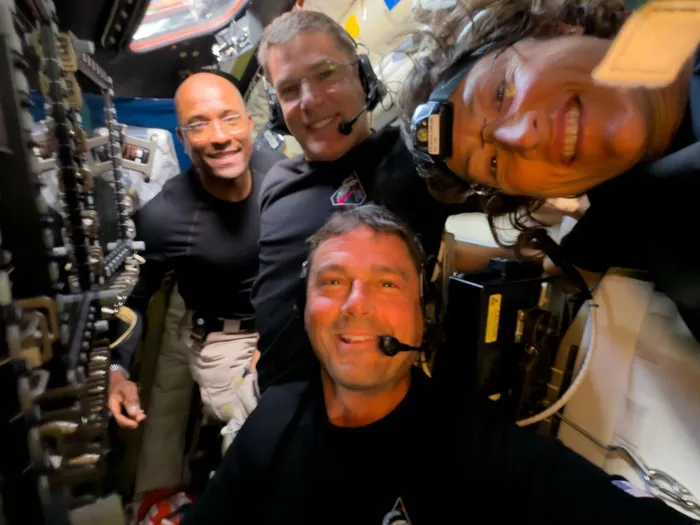
The successful splashdown of the Orion spacecraft following the Artemis II mission represents more than a biological proof of concept; it validates the structural transition from low Earth orbit (LEO) sortie operations to a sustainable cislunar supply chain. While public discourse focuses on the chronological records broken, the engineering reality centers on the stress-testing of three critical technical pillars: the integrated heat shield performance during a skip-reentry trajectory, the life support systems' management of metabolic waste over an extended high-radiation duration, and the precision of the recovery architecture in the Pacific Ocean.
The Physics of High-Velocity Reentry Managed via Skip-Entry
Returning from the Moon involves kinetic energy levels significantly higher than those encountered during return from the International Space Station (ISS). An Orion capsule returning from lunar distance hits the atmosphere at approximately 11,000 meters per second (roughly Mach 32), compared to the 7,800 meters per second of LEO returns.
The heat shield must dissipate energy equivalent to $E_k = \frac{1}{2}mv^2$. Because velocity is squared, a lunar return generates roughly twice the heat of a LEO return. Artemis II utilized a "skip-entry" maneuver to mitigate this thermal load and increase landing precision. In this maneuver, the capsule enters the upper atmosphere, uses its aerodynamic lift to "hop" back out into space briefly, and then performs a final descent.
This technique serves two strategic functions:
- Thermal Load Distribution: By splitting the reentry into two phases, the peak heat flux is reduced, preventing the Avcoat ablator from degrading prematurely.
- Range Extension: The skip allows the spacecraft to travel thousands of miles from the initial entry point to a specific recovery zone, decoupling the landing site from the rigid constraints of the orbital return path.
Life Support Reliability in the Van Allen Belts
The Artemis II mission profile forced the Orion Environmental Control and Life Support System (ECLSS) to operate in a high-stress environment that LEO missions avoid. The transit through the Van Allen radiation belts—zones of energetic charged particles trapped by Earth’s magnetic field—requires a specific shielding strategy and system redundancy.
Radiation protection on Artemis II was not merely about lead lining, which is mass-prohibitive. Instead, the crew utilized "sheltering" techniques, using the spacecraft’s existing mass (water supplies and equipment) to create a denser barrier during solar particle events. The mission's data confirms the viability of the Hybrid Electronic Radiation Assessor (HERA) system, which provides real-time warnings to the crew.
The ECLSS had to maintain a precise atmospheric mix while scrubbing carbon dioxide for four humans in a pressurized volume of only 9 cubic meters of habitable space. Unlike the ISS, which uses large, regenerative systems for oxygen and water, Orion uses a more compact, non-regenerative setup designed for the high-intensity, short-duration transit phases of deep space travel. The success of this mission proves that the nitrogen/oxygen recharge system can maintain physiological baselines under the metabolic load of an active crew performing manual piloting maneuvers.
The Cislunar Communications Bottleneck
A significant finding from the Artemis II mission is the requirement for high-bandwidth telemetry during the transition from the Deep Space Network (DSN) to the Near Space Network (NSN). As the spacecraft moves from the Moon back toward Earth, it must hand over communication links between massive ground-based radio telescopes and the smaller, more agile tracking stations used for reentry.
The "Blackout Zone" during reentry—caused by the ionization of air into plasma around the capsule—remains a period of zero data flow. Artemis II minimized this window by utilizing the TDRS (Tracking and Data Relay Satellite) constellation at higher altitudes, allowing for data acquisition much sooner than during the Apollo era. This reduction in "dark time" is vital for the Mission Control Center (MCC) to verify the health of the crew before the parachutes deploy.
Structural Integrity of the Service Module and Crew Module Interface
The European Service Module (ESM) provides the propulsion and power necessary for the Trans-Earth Injection (TEI) burn. A critical failure point in any lunar architecture is the separation of the Service Module from the Crew Module prior to reentry.
- Propulsive Margin: The ESM must retain enough propellant (Monomethylhydrazine and Nitrogen Tetroxide) to perform course corrections until the final hours of flight.
- Separation Dynamics: The pyrotechnic separation must occur cleanly to ensure the Service Module does not interfere with the Crew Module’s aerodynamic profile or become a collision hazard during the skip-entry.
Artemis II demonstrated that the umbilical connections—carrying power, data, and coolant—severed without debris interference. This confirms the reliability of the "frangible nut" and bolt-cutter mechanisms that are the single points of failure for the entire return sequence.
Quantitative Assessment of Recovery Logistics
The splashdown in the Pacific Ocean is the final phase of the recovery architecture. The U.S. Navy and NASA utilize a specialized landing platform dock (LPD) ship to recover the capsule. The "record-breaking" nature of the mission is often measured in miles, but the true metric is the Recovery Window Accuracy.
Artemis II targeted a "landing box" of only a few square kilometers. Achieving this after a 240,000-mile journey requires a guidance, navigation, and control (GNC) system that accounts for lunar gravity gradients, solar pressure, and atmospheric density fluctuations. The recovery process involves:
- Parachute Sequencing: Deployment of two drogue chutes at 25,000 feet to stabilize the craft, followed by three massive main chutes at 9,500 feet.
- Uprighting System: The deployment of five flotation bags to ensure the capsule remains apex-up in the swells, preventing the "Stable II" (inverted) position that plagued early Mercury and Apollo tests.
- Hazard Mitigation: Neutralizing residual hypergolic propellant fumes before the crew egresses to ensure the recovery divers are not exposed to toxic oxidizers.
The Pivot to the Lunar Gateway and Sustainable Presence
With the recovery of the Artemis II crew, the focus shifts from "sortie" missions—where the spacecraft returns immediately—to "hub-and-spoke" logistics. The data gathered from the Orion’s performance during this mission dictates the final design parameters for the Lunar Gateway, a small space station that will orbit the Moon.
The mission confirms that the Orion can serve as the "taxi" for these longer-duration stays. However, the constraints of the heat shield and the finite life support consumables mean that the Gateway must act as the primary life-support buffer for Artemis III and beyond. The "bottleneck" is no longer the ability to reach the Moon, but the ability to maintain the hardware in the harsh radiation environment of the Near-Rectilinear Halo Orbit (NRHO) for months at a time.
Future missions will require a transition from the current "disposable" service module model to a more integrated, potentially refuelable architecture. The Artemis II return proves the "Earth-Return" leg of the journey is solved; the next challenge is the "Surface-to-Orbit" leg, which requires the Starship Human Landing System (HLS) to perform a complex cryogenic refueling operation in LEO before even departing for the Moon.
The strategic imperative now lies in the industrialization of these flight profiles. NASA must move from "experimental" launches to a "cadence-based" model. This requires a stabilization of the supply chain for the RS-25 engines and the Solid Rocket Boosters (SRBs), which are currently the primary cost drivers of the Space Launch System (SLS). Reducing the "cost-per-seat" to the lunar surface will depend on the successful reuse of avionics and the optimization of the recovery fleet’s operational tempo.
The data from the Artemis II splashdown must be fed into the flight software for the HLS docking maneuvers. The oscillation frequencies observed during the Orion’s docking with the ESM provide the baseline for how the much larger Starship will interact with the Orion in lunar orbit. If the structural dampening is not precisely modeled, the kinetic energy of docking could compromise the pressure vessels of both crafts. Therefore, the immediate tactical priority is the rigorous Fourier analysis of the vibration data from the Artemis II mission recorders to refine the docking control laws for Artemis III.