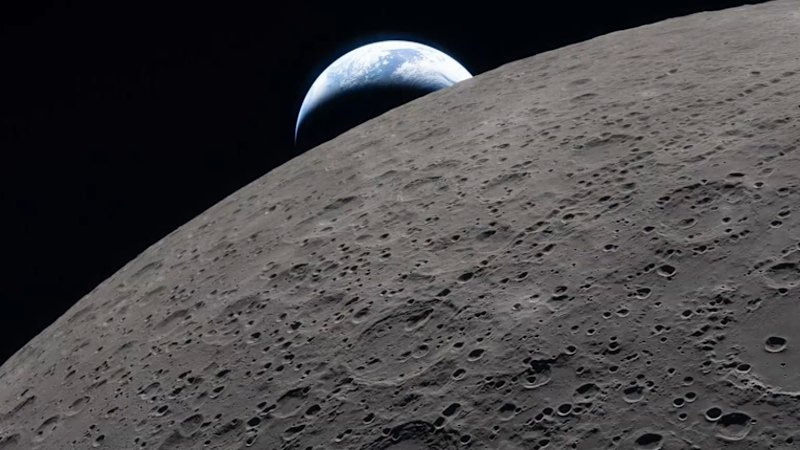
The term "dark side of the moon" is a persistent misnomer that obscures the fundamental orbital mechanics and geological asymmetry of the lunar body. From a data-driven perspective, we are discussing the Lunar Farside, a hemisphere characterized not by a lack of photon flux—it receives as much sunlight as the Earth-facing side—but by a profound lack of direct electromagnetic communication with terrestrial base stations. The distinct divergence between the nearside and farside is not merely visual; it is a structural anomaly that dictates the future of radio astronomy and lunar settlement logistics.
The Crustal Asymmetry Paradox
The most striking observation of farside imaging is the near-total absence of maria, the dark basaltic plains prevalent on the nearside. Analysis of the Lunar Reconnaissance Orbiter (LRO) data reveals that the farside crust is significantly thicker—averaging 50 kilometers compared to the nearside’s 30 kilometers. This thickness creates a massive thermal and mechanical bottleneck.
- Magmatic Suppression: On the nearside, the thinner crust allowed large-scale impacts to trigger volcanic upwelling, filling basins with lava.
- Thermal Insulation: The Procellarum KREEP Terrane (PKT), a region enriched in heat-producing elements like potassium, rare-earth elements, and phosphorus, is concentrated almost exclusively on the nearside.
- Impact Resultants: Without the cushioning effect of a warm, thin crust and subsequent volcanic resurfacing, the farside remains a chaotic record of 4.5 billion years of bombardment, preserved in high-relief topography.
This asymmetry means the farside is not a "mirror" of the moon we see from Earth; it is a fundamentally different geologic archive. The South Pole-Aitken (SPA) basin, a 2,500-kilometer-wide impact crater on the farside, represents the deepest known excavation of the lunar mantle. Measuring the mineralogical composition of the SPA basin provides a direct window into the early solar system’s volatile history that the nearside cannot offer.
The Radio-Quiet Zone: A Strategic Natural Resource
The most valuable commodity on the lunar farside is silence. Earth-based radio astronomy faces an escalating noise floor due to the proliferation of satellite constellations (Starlink, Kuiper) and terrestrial telecommunications. The moon acts as a physical shield, blocking the vast majority of human-generated Radio Frequency Interference (RFI).
This "Radio-Quiet Zone" (RQZ) is the only location in the inner solar system capable of detecting low-frequency radio waves (below 30 MHz). These frequencies are critical for observing the Cosmic Dark Ages, the period before the first stars formed. On Earth, these signals are absorbed or reflected by the ionosphere. On the lunar farside, the signal-to-noise ratio improves by orders of magnitude.
Establishing an observatory in this region involves a specific cost function:
- Relay Dependency: Because the farside has no line-of-sight to Earth, a constellation of relay satellites at the Earth-Moon L2 Lagrangian point is mandatory for data backhaul.
- Thermal Cycling: Instruments must survive two-week-long nights where temperatures drop to -173°C, requiring either Radioisotope Thermoelectric Generators (RTGs) or advanced phase-change material batteries.
- Landing Complexity: The rugged terrain of the farside, characterized by higher crater density and steeper slopes, increases the probability of landing failure compared to the relatively flat maria of the nearside.
Analyzing the South Pole-Aitken (SPA) Basin as a Strategic Asset
The SPA basin is the primary target for both scientific and resource-acquisition missions. Its depth exposes the lunar lower crust and potentially the upper mantle. This allows for a "vertical" analysis of lunar formation.
Mechanism of Mantle Exposure
The impact that created the SPA was so energetic that it stripped away the upper crust. Remote sensing data from missions like China’s Chang’e-4—the first to land on the farside—indicate the presence of low-calcium pyroxene and olivine. These minerals are consistent with a deep-seated origin. If humans can sample these materials, we move from speculative models of the Moon’s "Magma Ocean" phase to empirical proof of how planetary bodies differentiate.
Beyond geology, the SPA basin sits adjacent to the lunar south pole, where "Permanently Shadowed Regions" (PSRs) harbor water ice. The proximity of the farside’s unique radio-quiet properties to the south pole’s potential fuel resources creates a "High-Value Zone." Any entity that controls the communication relays over the farside effectively controls the flow of data from the most important scientific site of the 21st century.
Logistical Bottlenecks of Farside Exploration
While the images captured by the LRO and Chang’e-4 provide high-resolution visual data, the operational reality of the farside is one of severe constraint. We must define the three primary friction points for any farside strategy.
1. Data Latency and Throughput
A relay satellite at L2 adds a layer of complexity to tele-operations. The signal must travel from the farside lander to the relay, then to Earth, then back. While the light-speed delay is only ~1.3 seconds each way, the bandwidth is limited by the power output of the relay satellite. We cannot currently stream 8K video from the farside; we are limited to compressed telemetry and burst-mode imaging.
2. Surface Mobility Limitations
The lack of flat plains (maria) means rovers face a much higher "Energy Cost per Meter." On the nearside, a rover can traverse kilometers of relatively smooth regolith. On the farside, constant elevation changes and boulders ejected from ancient impacts necessitate autonomous navigation systems with high-frequency LIDAR sensing to avoid catastrophic tip-overs.
3. The Power Storage Problem
Solar power is the default for lunar missions, but the 14-day lunar night is a hard limit. Without the PKT’s radioactive heat-producing elements found on the nearside, the farside is a "cold trap." Surviving the night requires massive mass-allocation for batteries or heater units, which reduces the scientific payload capacity.
The Geopolitical Dimension of Farside Imaging
High-resolution imaging of the farside serves a dual purpose: scientific discovery and territorial "pre-emption." By mapping potential landing sites in the SPA basin with sub-meter precision, space agencies are identifying the "peaks of eternal light"—specific high-altitude spots near the pole that receive almost constant sunlight.
These peaks are the "high ground" of the lunar farside. Mapping them is the first step in a colonial-industrial framework. The images we see today are not just aesthetic; they are topographical maps for future infrastructure. The country or corporation that maps the best landing corridors and places the first stable relay constellation establishes a de facto monopoly on farside access.
Strategic Directive for Deep Space Observation
To maximize the utility of the lunar farside, the focus must shift from "imaging" to "interference-free infrastructure." The next phase of lunar development will not be defined by who takes the best photo, but by who builds the most robust communication bridge.
The immediate requirement is the deployment of a dedicated lunar orbital network. This network must provide:
- Continuous S-Band and Ka-Band Coverage: To ensure uninterrupted tele-robotics.
- Atomic Clock Synchronization: For precise positioning, navigation, and timing (PNT) on the surface.
- Modular Relay Nodes: To allow private and public entities to "plug in" to the network, lowering the barrier to entry for farside exploration.
Future missions must prioritize the deployment of low-frequency radio arrays in the Von Kármán crater. This is the optimal site for probing the 21cm hydrogen line from the early universe. By treating the farside as a specialized laboratory rather than just a photographic curiosity, we leverage its unique physical properties—shielding, depth, and isolation—to solve fundamental questions in cosmology that are unreachable from Earth's orbit.
The move toward the farside is a transition from a nearside "beachhead" strategy to a comprehensive lunar-orbital economy. Operations here are high-risk and high-cost, but the data-yield in terms of early-universe physics and mantle composition is unmatched by any other terrestrial or orbital platform.