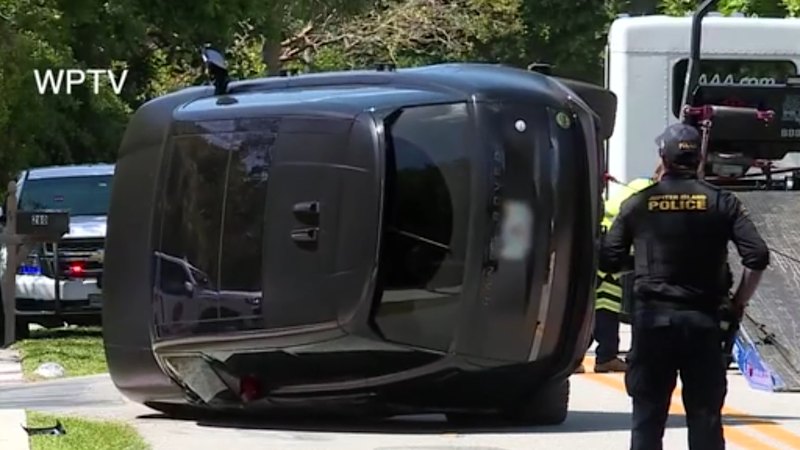
The morning air in Rolling Hills Estates usually carries the scent of eucalyptus and expensive damp earth. It is a quiet, rhythmic place. On February 23, 2021, that rhythm broke against a wooden sign and a tree.
We often view icons as untouchable machines, forgetting that they are subject to the same laws of physics and biology that govern us all. When the black Genesis GV80 SUV crossed the center divider on Hawthorne Boulevard, it wasn't just a vehicle drifting out of its lane. It was the physical manifestation of a body pushed past its breaking point and a mind operating in a fog of recovery. To understand the wreckage, you have to look past the twisted metal and into the quiet desperation of a man trying to outrun his own skeleton.
The Physics of a Falling Star
Hawthorne Boulevard is a deceptively steep stretch of road. If you aren’t riding the brakes, gravity takes over. Data later recovered from the vehicle's "black box" showed that the SUV was traveling at speeds between 84 and 87 miles per hour in a 45-mile-per-hour zone. There was no evidence of braking. Instead, the accelerator was depressed at 99 percent.
Imagine the disconnect.
Psychologists often speak of "automaticity"—the way we perform complex tasks like driving or swinging a golf club without conscious thought. But when the nervous system is frayed, automaticity fails. Investigators concluded that Woods likely hit the gas pedal thinking it was the brake. In that split second, the muscle memory that had won fifteen majors betrayed him. He wasn't reckless in the way a teenager is reckless. He was lost in the cabin of a luxury tank, his reaction times dulled by the weight of multiple back surgeries and a legacy of physical trauma.
The SUV hit the curb, took down a tree, and flipped several times. It was a violent, chaotic tumble through the brush. When the dust settled, the vehicle was on its side, and the greatest golfer of a generation was trapped inside, his right leg shattered into a map of jagged bone and crushed tissue.
The Invisible Weight of the Comeback
To be Tiger Woods is to live in a state of permanent repair. We cheered for the 2019 Masters win, calling it the greatest comeback in sports history. We saw the fist pump; we didn't see the ice baths, the injections, or the mornings where he couldn't get out of bed without help.
At the time of the crash, Woods was recovering from his fifth back surgery—a microdiscectomy intended to shave down a bone spur that was pinching a nerve. For a man whose entire life is built on the violent, rotational torque of a golf swing, a back surgery isn't just a medical procedure. It is a threat to his identity.
Consider the mental load of that morning. He was headed to a photoshoot with NFL stars Justin Herbert and Drew Brees. He was running late. In the world of elite performance, being late is a sin. The pressure to maintain the image of the invincible "Tiger" likely fueled the heavy foot on the pedal. We demand that our heroes be superhuman, but we rarely stick around to watch the maintenance required to keep the engine running.
The Brutal Reality of the Emergency Room
When first responders arrived, they found Woods conscious but disoriented. He didn't remember driving. He didn't know where he was. The trauma to his right leg was so severe it required a "comminuted open fracture" repair. In plain English: the bone was broken into several pieces and had pierced the skin.
Surgeons at Harbor-UCLA Medical Center had to insert a rod into the tibia to stabilize it. They used a combination of screws and pins to hold the foot and ankle together. To relieve the pressure from swelling, they had to perform a fasciotomy—cutting open the skin and the tough tissue surrounding the muscles. It is a gruesome, necessary violence intended to save a limb from rotting from the inside out.
He survived because the SUV did exactly what it was engineered to do. The interior "safety cell" remained intact, acting as a cocoon against the forest and the pavement. Had he been in a smaller, older car, the narrative would have ended that morning on the side of a California road.
The Myth of the Easy Road
There is a common misconception that wealth and fame provide a shortcut through recovery. They don't. A billionaire’s nerve endings fire the same way a janitor’s do. The weeks following the accident were spent in a hospital bed, not a victory lap.
The public immediately began asking: Will he play again? It is a selfish question. It ignores the fact that for a man with a shattered ankle and a fused back, simply walking to the kitchen to get a glass of water is a major championship. The "human element" isn't the trophy; it's the grueling, repetitive boredom of physical therapy. It’s the sweat on the brow in a private gym while the rest of the world debates your legacy on television.
Woods later admitted that there was a point where "the limb was on the table," meaning amputation was a very real possibility. That he kept the leg is a miracle of modern medicine. That he eventually walked onto the grounds of Augusta National again is a testament to a level of obsession that borders on the pathological.
The Silence After the Crash
The Los Angeles County Sheriff’s Department eventually cleared Woods of any criminal charges. There were no signs of impairment from drugs or alcohol at the scene. It was labeled a "pure accident." But "accident" is a word we use to tidy up the messy intersections of human error and physical exhaustion.
The real story isn't the speed or the curve in the road. It is the vulnerability of a man who has spent forty years trying to be a statue. For a few terrifying seconds in February, the statue broke.
We look at the wreckage and see a cautionary tale about speeding. But if you look closer, you see something much more relatable. You see a person who was tired, who was hurting, and who was trying to keep up with the impossible version of himself that the world created.
The SUV is gone, crushed and recycled. The road has been repaired. The eucalyptus trees continue to grow. But the man who crawled out of that windshield is different. He moves slower now. He limps. He feels the dampness in the air in his marrow. He is a reminder that even the most celebrated among us are only ever one misstep, one heavy foot, one moment of distraction away from the earth.
He sits in his cart now, looking out over the green fairways, a map of scars hidden beneath his polo shirt. The roar of the crowd is quieter these days, replaced by the steady, rhythmic thumping of a heart that knows exactly how lucky it is to still be beating.