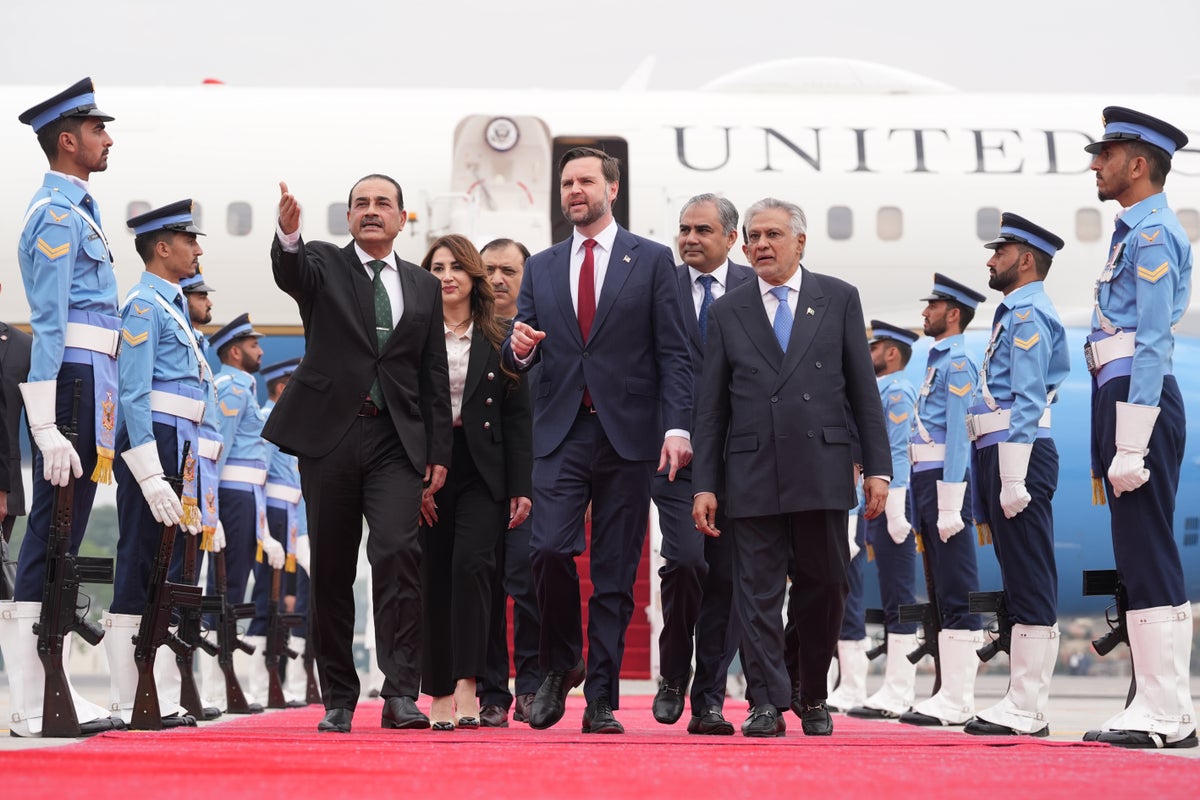
The convergence of high-level diplomatic engagement in Islamabad and military escalation in the Strait of Hormuz represents a classic dual-track strategy designed to manipulate risk premiums and diplomatic leverage. While the headlines focus on the novelty of Pakistan as a mediator, the underlying mechanics are governed by two distinct structural forces: the Escalation Ladder of Maritime Interdiction and the Triangulation of Third-Party Mediation. To understand the current friction, one must look past the optics of "peace talks" and analyze the kinetic and economic variables at play in the Persian Gulf.
The Strait of Hormuz as a Kinetic Lever
The deployment of warships into the Strait of Hormuz is not a mere show of force; it is a recalibration of the Cost-to-Transit Function for global energy markets. The Strait remains the world’s most sensitive maritime choke point, facilitating the passage of approximately 21 million barrels of oil per day. When naval assets enter this theater during active negotiations, they function as a physical hedge against diplomatic failure.
The tactical utility of the Strait for Iran and the United States operates on three levels of friction:
- Grey Zone Maneuvering: Utilizing non-state actors or fast-attack craft to create deniable interference. This forces the adversary to spend disproportionate resources on escorting commercial vessels.
- The Insurance Premium Spike: Physical presence increases the War Risk Surcharge (WRS) for shipowners. Even without a shot fired, the movement of warships signals a shift in the "Probability of Interruption" variable, directly impacting global Brent crude pricing.
- Command of the Narrative: By placing ships in the Strait, the U.S. Navy asserts the "Freedom of Navigation" principle, while Iran’s proximity allows it to demonstrate "Territorial Sovereignty Claims."
The presence of these vessels during the Pakistan talks creates a Deadman’s Switch logic. If the talks stall, the proximity of naval assets ensures that the transition from diplomacy to kinetic exchange is instantaneous, removing the "buffer time" that usually allows for cooling-off periods.
The Pakistan Mediation Framework: Why Islamabad?
Choosing Pakistan as a venue over traditional intermediaries like Oman or Switzerland signals a shift toward a Regional Security Bloc approach. Pakistan’s involvement is defined by its unique "Shared Border Vulnerability" and its deep-seated economic ties to both the Gulf Monarchy system and the Iranian energy sector.
The mediation logic follows a Trilateral Interest Convergence:
- The Border Security Constraint: Both Iran and Pakistan face insurgency issues in the Balochistan region. Stability in one is contingent upon the cooperation of the other. By hosting these talks, Pakistan leverages its role as a security provider to ensure that any U.S.-Iran deal includes provisions for regional border stability.
- The Debt-Energy Swap: Pakistan’s chronic energy shortages and its obligations under the Iran-Pakistan (IP) gas pipeline project create a powerful incentive. Islamabad is not a neutral arbiter; it is a stakeholder seeking a sanctions-relief framework that allows it to complete its energy infrastructure without triggering U.S. "CAATSA" penalties.
- The China Factor: As a primary architect of the China-Pakistan Economic Corridor (CPEC), Beijing’s tacit approval of this venue suggests a broader Eurasian attempt to stabilize the Middle East to protect the "Belt and Road" logistics chains.
The Mechanics of the Negotiating Table
The current talks are structured around the Theory of Incremental Reciprocity. Unlike previous attempts at a "Grand Bargain," these discussions focus on isolated variables to build a baseline of trust.
The Nuclear Breakout Variable
The primary U.S. objective remains the extension of the "Breakout Time"—the duration required for Iran to produce enough weapons-grade uranium for a single nuclear device. Current estimates place this at a critical threshold. The negotiation must address the $U^{235}$ enrichment levels, specifically the stockpiles of 60% enriched material.
The Sanctions Liquidity Trap
For Iran, the primary objective is the "Repatriation of Frozen Assets." This is not just about the volume of capital but the Velocity of Access. Iran requires the ability to use the SWIFT banking system to facilitate legitimate trade, bypassing the "Shadow Banking" networks that currently eat 20% to 30% of their revenue in transaction costs and middleman fees.
Regional Hegemony and Proxy Management
A significant bottleneck in these talks is the Proxy Decoupling Problem. The U.S. demands that Iran exert "Command and Control" over its regional affiliates (the "Axis of Resistance"). However, from a strategic standpoint, these proxies represent Iran’s "Forward Defense" capability. Surrendering influence over these groups without a formal security guarantee from the West would create a tactical vacuum that Iran is unwilling to accept.
Measuring the Risk of Miscalculation
The simultaneous occurrence of naval maneuvers and diplomatic dialogue introduces the Signal-to-Noise Ratio problem. In a high-tension environment, a tactical error by a ship commander in the Strait—a "Hot Bridge" incident—can override months of diplomatic progress.
The risk is quantified through the Security Dilemma framework:
- State A (U.S.) deploys ships to ensure safety.
- State B (Iran) perceives this as an offensive posture and readies its coastal batteries.
- State A sees the battery activation and increases its readiness.
This feedback loop creates a situation where the "Cost of De-escalation" becomes higher than the "Cost of Maintenance." Each side fears that backing down will be interpreted as weakness at the Islamabad negotiating table.
The Economic Implications of a Breakthrough
If the Pakistan talks yield a memorandum of understanding, the primary market reaction will be a Volatility Compression in energy futures. The "Geopolitical Risk Premium," which often adds $5 to $10 to the price of a barrel, would evaporate.
However, the "Execution Risk" remains high. A deal in Islamabad must survive the legislative scrutiny of the U.S. Congress and the internal power dynamics of the Iranian Supreme National Security Council. The structural limitation here is the Credible Commitment Problem: Iran fears that a future U.S. administration will unilaterally exit any agreement, while the U.S. fears that Iran will use sanctions relief to fund further military modernization rather than civilian infrastructure.
Strategic Forecast and Operational Reality
The most probable outcome is a Localized De-escalation Agreement rather than a comprehensive peace treaty. This would likely involve a "Freeze-for-Freeze" mechanism: Iran pauses enrichment at the 60% threshold in exchange for limited, monitored waivers on oil exports to specific Asian markets.
The naval presence in the Strait will not diminish immediately. Instead, look for a transition to a Regulated Posture, where notification protocols for transit are strictly followed to prevent accidental engagement. The success of the Islamabad channel will be measured not by a signed document in the short term, but by a measurable decrease in the frequency of "Unsafe and Unprofessional" encounters at sea.
Expect a pivot toward Technical Verification Teams entering Iran as the next tactical step. If these teams are granted access to sites like Fordow or Natanz without friction, it will indicate that the Islamabad talks have successfully decoupled the maritime tension from the core nuclear dispute. If access is denied, the warships currently in the Strait will shift from a "Signaling" role to an "Interdiction" role, likely targeting "Ghost Fleet" tankers to re-establish economic pressure. The window for this diplomatic calibration is narrow, dictated by the internal political cycles of both nations. The immediate strategic move for observers is to monitor the Baltic Dirty Tanker Index and the CBOE Crude Oil Volatility Index (OVX); these will provide the first data-driven confirmation of whether the Islamabad rhetoric matches the reality of the water.