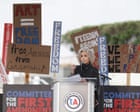
Jane Fonda stood on a makeshift stage, her voice amplified against a backdrop of federal architecture, issuing a demand for resistance that felt less like a celebrity cameo and more like a tactical briefing. The rally she led wasn’t merely a protest against budget cuts; it was an indictment of a systemic effort to dismantle the infrastructure of American dissent. While the headlines focused on the star power, the actual mechanics of the crackdown involve a sophisticated use of federal levers to choke the lifelines of independent media and the arts. This is a calculated shift in how power manages the narrative, moving from public debate to administrative strangulation.
The current administration has moved beyond rhetoric. It is now targeting the financial and legal frameworks that allow creators and journalists to operate outside of state-approved boundaries. By threatening the tax-exempt status of non-profit newsrooms and proposing the total elimination of the National Endowment for the Arts (NEA), the government isn't just saving pennies in a multi-trillion-dollar budget. It is removing the insulation that protects cultural workers from the whims of the market and the retaliation of the state.
The Financial Noose Around Public Media
Federal funding for the arts and public broadcasting represents a rounding error in the national deficit. The persistence in attacking these specific line items suggests the motivation is ideological, not fiscal. When the Corporation for Public Broadcasting (CPB) faces a "zeroing out" of its budget, the impact doesn't hit the major metropolitan hubs first. Places like New York City or Los Angeles have the donor density to survive. The real casualties are the rural radio stations and local news outlets in Middle America.
In many of these regions, the local public radio station is the only source of non-conglomerated news. If you remove the federal seed money, the entire structure collapses. Private equity firms then swoop in to buy the remaining assets, stripping the local reporting staff and replacing them with syndicated, hyper-partisan content. This is how "news deserts" are manufactured. It isn't a natural evolution of the industry; it is a policy choice.
Cultural Capital as a National Security Threat
Art has always been the first target for regimes looking to consolidate power. This isn't because a painting can topple a government, but because art provides the vocabulary for alternative realities. When Fonda spoke about "breaking the silence," she was referencing the specific way that state-funded arts programs encourage questioning the status quo.
The strategy currently in play involves redefining "obscenity" or "community standards" to justify the withdrawal of grants. By making the criteria for funding intentionally vague, the government creates a chilling effect. Creators begin to self-censor, avoiding controversial themes to ensure their organizations can pay rent. This "anticipatory obedience" is far more effective than direct censorship because it leaves no fingerprints. The art simply never gets made.
The Weaponization of the FCC
Broadcast licenses have become a new front in this war. The Federal Communications Commission (FCC) is being pressured to review the licenses of networks that air critical coverage of the administration. While the legal bar for revoking a license is incredibly high, the mere threat of a protracted legal battle is enough to make corporate boardrooms nervous.
Investors hate volatility. If a news organization becomes a lightning rod for federal litigation, the stock price dips. Shareholders then demand a "pivot" toward safer, less confrontational content. We are seeing a slow-motion alignment of corporate interests and state power, where the desire for profit creates a natural incentive to avoid the "hard-hitting" journalism that Fonda and her cohorts are desperate to protect.
The Myth of the Independent Marketplace
A common counter-argument is that if the arts and media are valuable, the "market" will support them. This is a fundamental misunderstanding of how cultural value is created. Markets prioritize what is popular and profitable in the short term. Journalism and the arts often provide value that is essential but not immediately monetizable.
Investigative reporting on local corruption might take six months to produce and cost tens of thousands of dollars. It won't generate the "clicks" that a viral celebrity scandal will, but it might save a municipality millions in diverted tax funds. When the state removes its support for these public goods, it isn't "freeing" the market. It is ensuring that only the loudest, richest voices can afford to speak.
Celebrity Activism and the Risk of Distraction
There is a danger in having Jane Fonda as the face of this movement. Her involvement, while bringing much-needed visibility, allows critics to dismiss the movement as the hobby of the "liberal elite." The administration uses this optics gap to frame the struggle as a class war—the wealthy actress versus the hardworking taxpayer.
This framing ignores the reality that the majority of people affected by these crackdowns are underpaid journalists, local museum curators, and public school art teachers. The "crackdown" isn't happening in Hollywood penthouses; it’s happening in basement newsrooms in Ohio and community centers in Florida. The focus on the celebrity often obscures the granular, everyday erosion of civil liberties.
The Playbook of Administrative Friction
The crackdown doesn't always look like a dramatic raid or a public ban. More often, it looks like "administrative friction." It’s the sudden audit of a documentary filmmaker’s taxes. It’s the new "transparency" requirement that forces non-profits to disclose their donors, exposing those donors to public harassment. It’s the slowing down of Press Secretary credentials for outlets that ask uncomfortable questions.
These are the tools of a bureaucracy weaponized against its own observers. By making it difficult, expensive, and legally risky to practice journalism or produce provocative art, the state achieves its goal without ever having to pass a law that would be struck down by the Supreme Court. They aren't breaking the First Amendment; they are making it too expensive to use.
The Global Context of the American Shift
What Fonda is warning against isn't happening in a vacuum. We are seeing a global trend toward "illiberal democracy," where the formal institutions of elections remain, but the guardrails of a free press and an independent judiciary are systematically dismantled. In countries like Hungary and Turkey, the takeover of the media didn't happen overnight. It was a decade-long process of tax investigations, forced sales to government-friendly oligarchs, and the weaponization of libel laws.
The United States is currently testing these same waters. The rhetoric regarding "enemies of the people" isn't just talk; it's the ideological justification for the policy shifts we are seeing at the NEA and the FCC. Once the public becomes desensitized to the idea that the media is the enemy, they are less likely to object when that media is financially strangled.
The Role of Digital Platforms
The crackdown extends into the digital realm, where the government is pressuring tech giants to "moderate" content under the guise of national security or public safety. While private companies have the right to curate their platforms, the line between corporate policy and government pressure is blurring.
When a federal agency "suggests" that certain narratives are harmful, and a platform responds by de-ranking that content in search results, the result is a soft censorship that is nearly impossible to track. This "algorithmic silencing" is the modern equivalent of the blacklists of the 1950s. You aren't banned from speaking; you're just ensured that no one will ever hear you.
Organizing for a New Era of Resistance
The rally Fonda led is a symptom of a broader realization: the old ways of protecting the press and the arts are no longer sufficient. Relying on "norms" or "tradition" is a losing strategy when the opposing force is willing to use every administrative tool at its disposal to achieve its ends.
Protecting the arts and media now requires a legal and financial insurgency. This means creating "firewalled" endowments that are immune to federal interference. It means developing decentralized platforms for news distribution that cannot be toggled off by a single regulatory body. It means a shift from asking the government for support to building a parallel infrastructure that the government cannot reach.
The silence Fonda warns against is already settling in some sectors. You can hear it in the "both-sidesism" of major news networks that are afraid to call a lie a lie for fear of losing access. You can see it in the "safe" programming choices of museums that once took risks. Breaking that silence isn't just about shouting louder at a rally; it’s about making the cost of silencing the public too high for any administration to pay.
The fight isn't about the budget for a few statues or a radio station. It is a battle over who gets to define the American reality. When the state controls the tools of storytelling, it controls the future. The only way to stop the crackdown is to make the act of dissent more resilient than the tools of the state. Stop waiting for a return to normalcy and start building the systems that can survive the new permanent crisis.