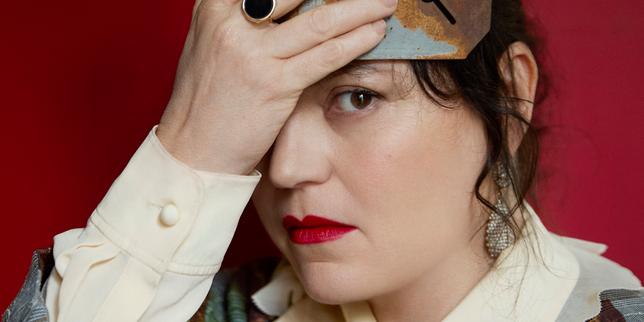
The selection of Yto Barrada to represent France at the 2026 Venice Biennale marks a definitive shift in how the French state attempts to reconcile its colonial past with its fractured present. Barrada, a French-Moroccan artist known for her meticulous documentation of the Strait of Gibraltar and the urban mutations of Tangier, does not produce the kind of celebratory, nationalist art traditionally expected from a Pavilion representative. Instead, her work often highlights the very borders and bureaucratic walls that France spent decades erecting. This choice is not a simple gesture of artistic merit; it is a calculated political move by the Ministry of Culture to outsource the critique of French identity to someone who bridges the gap between the hexagon and the Maghreb.
By sending Barrada to the Giardini, France is betting on an artist who specializes in the "un-making" of history. Her practice spans photography, film, sculpture, and textile, but the connective tissue is always a preoccupation with how power carves its mark onto the land and the people living on it. This is art that functions as a forensic report on the debris of empire. Recently making headlines in this space: The Kinetic Deficit Dynamics of Pakistan Afghanistan Cross Border Conflict.
The Strategy Behind the Selection
Choosing a representative for Venice is rarely about art alone. It is about soft power. For years, the French Pavilion has leaned into a specific type of intellectual provocation, but Barrada brings a different weight. She is a founder of the Cinémathèque de Tanger and a recipient of numerous international accolades, yet her work remains stubbornly grounded in the dirt and the dye-pits of Morocco.
The French cultural establishment is currently under fire for its perceived inability to integrate the voices of its former colonies into a cohesive national narrative. By selecting Barrada, they are signaling a willingness to let the "periphery" take center stage. This isn't just about representation; it is about institutional survival. If the state can embrace an artist who examines the failures of borders, perhaps it can claim to have transcended them. Additional details into this topic are explored by NPR.
The Mechanics of the Strait
To understand why Barrada’s work resonates now, one must look at her long-term obsession with the Strait of Gibraltar. This fourteen-kilometer stretch of water is not just a geographic feature; it is a cemetery, a barricade, and a dream. In her series A Pilot Plan for the City of Tangier, Barrada looked at how the city was being reshaped by tourism and the "modernity" imposed from the outside.
She captures the boredom of the border. While the media focuses on the high-drama crossings, Barrada focuses on the people waiting—the harraga (those who burn their papers) and those left in the shadows of luxury developments. She documents the flora that survives in the cracks of the asphalt. This is not "protest art" in the loud, neon sense. It is a quiet, persistent mapping of what happens when a person’s movement is restricted by the color of their passport.
The Fabric of Resistance
Barrada’s recent work with textiles and natural dyes offers a sharper critique of industrialization than any manifesto. She explores the history of color, specifically how the extraction of indigo and other pigments tied the North African economy to European demand. Her use of hand-dyed fabrics and "instructional" sculptures mocks the rigid, cold logic of Western modernism.
She often uses play as a subversive tool. Her sculptures might look like playground equipment or educational toys, but they are frequently based on the geometry of urban planning or the structures of colonial architecture. By turning these heavy concepts into objects that invite touch or curiosity, she strips them of their intimidating authority. She forces the viewer to interact with the skeletons of power.
Why the Biennale Demands More Than Aesthetics
The Venice Biennale is the "Olympics of the art world," a place where national egos are bruised or bolstered. For France, the stakes are particularly high. The pavilion itself is a relic of 19th-century geopolitical ambitions. When an artist like Barrada enters that space, the architecture itself becomes part of the piece.
Critics often argue that these appointments are "diversity washing," a way for the state to appear progressive while maintaining the status quo in its social policies. However, Barrada’s history suggests she is unlikely to play along. She has spent her career dodging the "representative" label, refusing to be a mouthpiece for any single identity. Her work is about the gaps—the things that are lost in translation or hidden in the archives.
The Problem of the National Pavilion
There is an inherent contradiction in representing a nation-state with work that deconstructs the idea of the nation. Barrada’s presence in Venice will highlight the friction between the French Republic’s universalist ideals and its specific, often exclusionary, history.
- The Archive: Barrada often uses found objects and historical documents to show how narratives are constructed.
- The Land: Her focus on botany and urbanism reveals how colonialism reshaped the physical environment, not just the political one.
- The People: She avoids the "poverty porn" trap, instead showing the dignity of those living in the "non-places" of the global economy.
The Logistics of the 2026 Presentation
While the specific contents of the 2026 exhibition remain under wraps, the commission points toward an expansive installation that will likely challenge the physical layout of the French Pavilion. Barrada is known for creating "ecosystems" rather than just hanging pictures on a wall. Expect an environment where film, sound, and smell converge to tell a story of migration and resilience that is as much about Marseilles or Paris as it is about Tangier.
The selection committee, led by influential curators and museum directors, reportedly chose her for her ability to speak to a global audience without losing her local specificity. This is the "Goldilocks" zone for Venice: art that is sophisticated enough for the critics but visceral enough to stop the casual tourist in their tracks.
Beyond the Mediterranean Myth
For too long, French art concerning North Africa has been stuck in the "Orientalist" trap—either romanticizing the landscape or treating the people as a monolithic problem to be solved. Barrada breaks this cycle. She treats Tangier and its connection to Europe as a complex, living laboratory.
She investigates the "fossil" economy, the way history becomes a commodity for tourists. In her film work, she often focuses on the labor that goes into creating the illusion of a seamless, globalized world. Whether it is the people making fake fossils for the gift shops or the workers maintaining the gardens of luxury hotels, she exposes the gears behind the curtain.
The Risk of Institutional Absorption
The danger for any radical artist representing a state is that the state eventually swallows the radicalism. When the French government awards you their highest platform, they are essentially claiming your work as a French achievement. Barrada’s challenge will be to maintain her outsider perspective while operating from the very heart of the establishment.
Her previous exhibitions at the Barbican in London or the MoMA in New York show a knack for remaining elusive. She doesn't provide easy answers. She doesn't tell you how to feel about the migrant crisis or the legacy of the protectorate. Instead, she presents the evidence and leaves you to deal with the discomfort. This refusal to simplify is exactly what makes her a formidable choice for Venice.
The Physicality of Memory
The use of traditional Moroccan techniques—weaving, embroidery, and dyeing—in a high-concept contemporary art setting is a political act. It reclaims the "craft" label and elevates it to the level of "fine art," a distinction that has historically been used to marginalize non-Western creators. Barrada isn't just showing art; she is demonstrating a method of survival.
She looks at how traditions persist despite the pressures of globalization. This isn't nostalgia. It is an investigation into what remains when the official structures fail. If the French state wants to know how to navigate a world where the old borders no longer hold, they could do worse than looking at the patterns Barrada finds in the dust of Tangier.
The 2026 Venice Biennale will serve as a referendum on this new direction for French cultural diplomacy. If the pavilion succeeds, it won't be because it made the audience feel good about the future of France. It will be because it forced them to look at the cracks in the foundation. Barrada’s work suggests that the only way to build something new is to first understand the wreckage of what came before. The art of the 50 nuances of reality is, ultimately, the art of seeing clearly when everyone else is looking away.