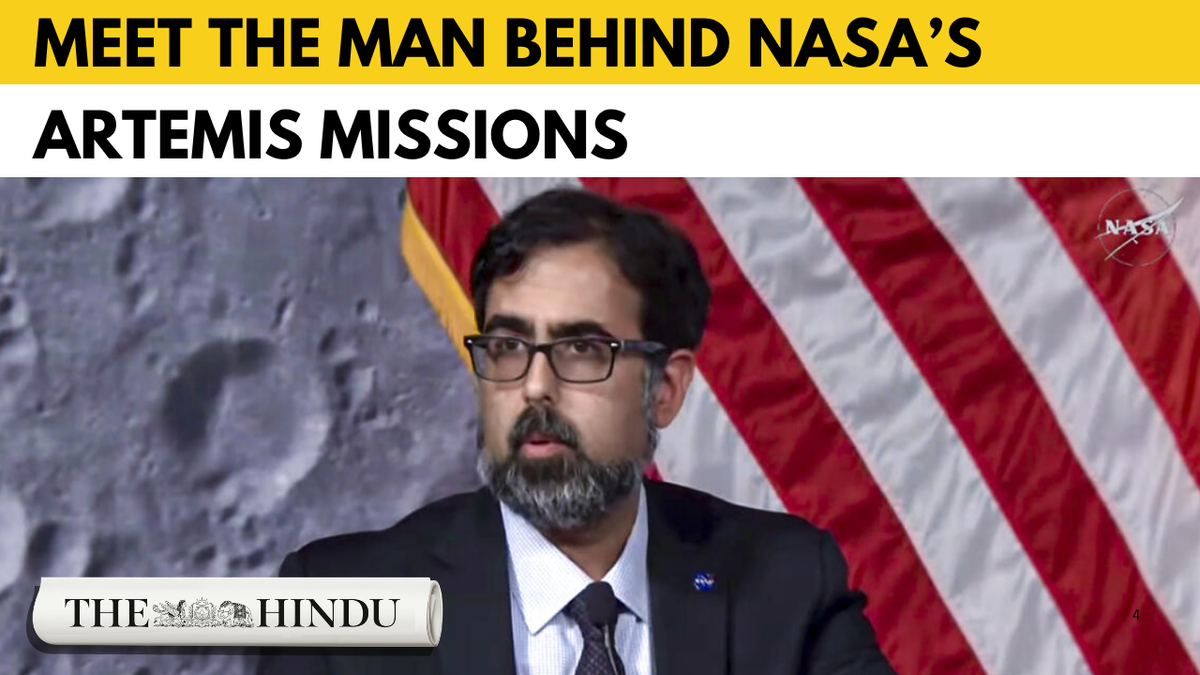
The room smells like stale coffee and the hum of high-voltage cooling fans. On a monitor across the room, a grainy video feed shows a landscape of gray dust and long, jagged shadows. It is quiet. Not the peaceful quiet of a Sunday morning, but the pressurized, heavy silence of a vacuum where a single loose screw or a line of buggy code means a billion-dollar tombstone floating in the dark.
Most of us look at the Moon and see a nightlight. Amit Kshatriya looks at it and sees a logistics problem.
He isn't a pilot. He doesn't wear a flight suit decorated with patches of bravery. Instead, he is the man who stays behind to make sure the people who do leave actually come back. As the inaugural head of NASA’s Moon to Mars Program Office, Kshatriya holds the blueprint for humanity’s next thousand years. If that sounds like hyperbole, consider the math of survival. Going to the Moon isn't just about the launch; it is about the architecture of staying.
The Weight of Every Ounce
The physics of space travel is a brutal accountant. Every gram of weight added to a spacecraft requires more fuel, which adds more weight, which requires more fuel. It is a recursive nightmare. For decades, we treated space like a camping trip—bring everything you need, then carry your trash home.
Kshatriya is changing the fundamental logic of the mission.
He grew up with a deep technical pedigree, a background in software engineering and robotics that taught him one thing: systems fail. They fail in ways you can't predict. On the International Space Station, where he spent years as a flight director, he learned the visceral reality of "off-nominal" events. When a cooling pump dies or a solar array jams, you don't call a repairman. You fix it with what you have on hand and the collective brainpower of a team three hundred miles below.
Now, he has to do that at a distance of 238,000 miles. Then, eventually, 140 million miles to Mars.
He isn't just building a rocket. He is building a bridge. The Artemis program, which he oversees from a high-level strategic perspective, is the most complex machine ever conceived. It involves the Space Launch System (SLS), the Orion spacecraft, the Gateway station in lunar orbit, and various private-sector landers. Kshatriya’s job is to ensure these disparate pieces of technology—built by different companies with different cultures—speak the same language.
The Human at the Center of the Machine
We often talk about "NASA" as a monolith, a giant marble building with a logo. But NASA is actually a collection of nervous systems. It’s thousands of people like Kshatriya who have to decide, on a Tuesday afternoon, whether a specific seal on a hatch is worth a three-month delay.
Kshatriya’s leadership style isn't defined by shouting orders. It’s defined by the "Human-in-the-Loop" philosophy. He understands that while AI and automation are necessary, the human element is the only thing that can handle the "unknown unknowns."
Imagine a hypothetical technician named Sarah. She’s working on the heat shield for the Orion capsule. She knows that if she misses a hairline fracture, the astronauts—real people with families and favorite songs—will vaporize upon re-entry. Kshatriya is the person who creates the culture where Sarah feels empowered to stop the line. He bridges the gap between the cold, hard data of engineering and the warm, terrifying reality of human life.
This is the invisible burden of the Moon to Mars office. It’s not just about the "How." It’s about the "Who."
Why This Isn't 1969 Again
People often ask why we are going back. We did this already, right? We planted the flag. We took the photos.
But the Apollo missions were a sprint. We ran to the Moon, stayed for a few hours, and ran back. It was a feat of incredible daring, but it wasn't sustainable. Amit Kshatriya is tasked with the marathon. He is designing a permanent presence. This involves "In-Situ Resource Utilization"—a fancy engineering term for living off the land.
He has to figure out how to mine the ice in the Moon’s permanently shadowed craters to create oxygen and rocket fuel. He has to oversee the construction of the Gateway, a small space station that will orbit the Moon, serving as a gas station, a laboratory, and a lifeboat.
Think of the Moon as a practice range. If we can't figure out how to survive on a rock that is only three days away, we have zero chance of surviving on a planet that is seven months away. Mars is the goal, but the Moon is the classroom. Kshatriya is the principal, the janitor, and the lead architect all at once.
The Engineering of Ego
One of the greatest challenges Kshatriya faces isn't gravity or radiation. It’s bureaucracy.
The Moon to Mars program involves international partners like the ESA (Europe), JAXA (Japan), and CSA (Canada), alongside private giants like SpaceX and Blue Origin. Coordinating these entities is like trying to conduct a symphony where half the musicians are playing different songs and the other half are trying to buy the concert hall.
Kshatriya’s expertise lies in integration. He has to take the wild, move-fast-and-break-things energy of the private sector and marry it to the safety-obsessed, methodical rigor of NASA. It’s a marriage of necessity. Without the private sector, we can’t afford to go. Without NASA, we don’t know how to stay safe.
He sits at the center of this tension. When a Starship prototype explodes on a test pad in Texas, he has to analyze the data to see how it affects the timeline for a lunar landing two years from now. He has to be the calmest person in the room when everything is on fire.
The Quiet Legacy
You won't see Amit Kshatriya's name in many history books for children. They will remember the names of the first woman and the first person of color to step onto the lunar dust. They will remember the "one small step" of the 21st century.
But those steps are only possible because of the thousands of hours Kshatriya spent staring at spreadsheets, risk assessments, and system diagrams. He is the one ensuring that when those astronauts look back at the Earth—a tiny, fragile blue marble hanging in the blackness—they know they have a way to get back to it.
He is the architect of the long walk home.
The work is grueling. It is often thankless. It involves more meetings than moonwalks. But when you ask why someone with his talent would dedicate their life to this, the answer isn't in the technology. It’s in the eyes of his own children. It’s the realization that we are currently a single-planet species, and history shows that single-planet species eventually become extinct.
Kshatriya is buying us insurance. He is building the lifeboats.
As the sun sets over the Kennedy Space Center, casting long shadows across the massive SLS rocket standing on Pad 39B, the magnitude of the task becomes clear. We are trying to do something that has never been done: make the heavens a neighborhood.
It starts with a man in an office, looking at a screen, making sure the math adds up. It ends with a footprint that will last for a million years, untouched by wind or rain, a permanent reminder that we weren't content to just stay on the ground.
The rocket is the muscle. The astronauts are the heart. But Amit Kshatriya is the mind, quietly calculating the distance between where we are and where we must go.