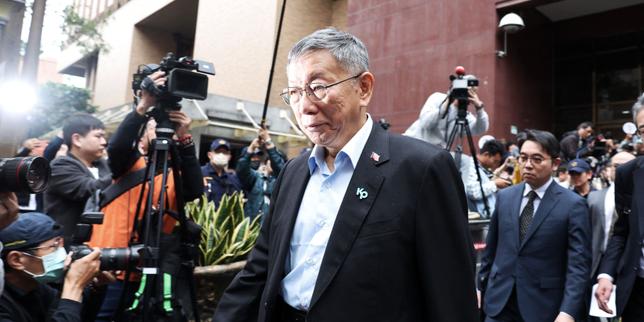
The sentencing of Ko Wen-je, founder of the Taiwan People’s Party (TPP), to seventeen years in prison for corruption marks the functional termination of a decade-long experiment in Taiwanese "Third Power" politics. This is not merely a legal verdict; it is a structural failure of a political model predicated on "technocratic purity" as an alternative to the established KMT-DPP duopoly. The 17-year sentence, centered on the Core Pacific City (Jing-Hua City) redevelopment project during Ko’s tenure as Mayor of Taipei, reveals a fundamental misalignment between the TPP’s anti-establishment rhetoric and the operational realities of municipal land-use bureaucracy.
To analyze the collapse of the TPP, one must evaluate the three structural pillars that sustained Ko Wen-je’s rise and identify the specific points where those pillars buckled under legal and administrative scrutiny.
The Tri-Polar Equilibrium and the Incentive for Deviation
Taiwanese politics has historically operated as a zero-sum game between the "Green" (Democratic Progressive Party) and "Blue" (Kuomintang) coalitions. Ko Wen-je’s entry into this space utilized a "White" brand identity, positioning itself as a pragmatic, data-driven alternative. The TPP’s value proposition relied on the assumption that corruption was an inherent byproduct of partisan ideology, and therefore, a non-ideological party would be immune to it.
The legal reality of the Core Pacific City case contradicts this proposition. The prosecution focused on the illegal increase of the Floor Area Ratio (FAR) from 392% to 840%. In urban planning, FAR is the primary lever for value extraction. By granting an unprecedented increase in buildable area, the Taipei City Government effectively created billions of New Taiwan Dollars in "paper wealth" for the developer.
The mechanism of the alleged corruption was not a simple cash-for-votes scheme, but a sophisticated manipulation of administrative discretion.
The Mechanism of FAR Manipulation
- Administrative Discretion: The city’s Urban Planning Commission was used to bypass standard zoning limitations.
- Value Conversion: Each percentage point of FAR increase translates directly into sellable square footage in one of the world’s most expensive real estate markets.
- Quid Pro Quo: The sentencing reflects the court's finding that these administrative favors were exchanged for illicit financial contributions, often masked as political donations or handled through intermediaries.
This creates a bottleneck for any third-party movement: without the established fundraising networks of the major parties, insurgent leaders face a higher incentive to engage in high-value, high-risk "special projects" to fund their national ambitions.
The Failure of the Technocratic Shield
Ko Wen-je’s primary defense throughout his career was his identity as a "scientific" leader. He frequently used the phrase "SOP" (Standard Operating Procedure) to suggest that his administration was governed by logic rather than influence. However, the 17-year sentence suggests that the "SOP" was either bypassed or weaponized.
In a data-driven analysis of the case, the breakdown occurs at the intersection of professional expertise and executive will. The Urban Planning Commission is designed to be a body of experts that checks the power of the Mayor. The investigation revealed that dissenting voices within the commission were marginalized or replaced.
The structural flaw in Ko's technocratic model was the Concentration of Executive Power. When a leader claims to be the sole arbiter of "truth" and "efficiency," the internal checks and balances of the bureaucracy are viewed as "inefficiencies" to be overcome. This led to a disregard for the legal guardrails that define Taiwanese administrative law.
The Cost Function of Political Outsiderism
- Institutional Isolation: Lacking a deep bench of experienced civil servants, the TPP relied on a small circle of loyalists who prioritized the leader’s directives over procedural legality.
- Information Asymmetry: Ko’s "non-traditional" background meant he lacked the long-term relationships within the bureaucracy that provide informal warnings when a policy is veering toward a criminal threshold.
- The Transparency Paradox: While campaigning on "open government," the decision-making process for the Core Pacific City project was notably opaque, demonstrating that transparency was a marketing tool rather than an operational constraint.
Strategic Implications for the Taiwanese Electorate
The removal of Ko Wen-je from the political chessboard for nearly two decades shifts the electoral calculus for the 2028 presidential cycle and beyond. The TPP’s core demographic—young, urban professionals and "swing" voters—now faces a crisis of representation.
The Fragmentation of the Youth Vote
The TPP successfully captured the "Small Grass" (Xiao Cao) movement by tapping into grievances regarding housing affordability and stagnant wages. With the leader of that movement convicted of inflating the profits of a massive property developer, the cognitive dissonance among his base is profound.
The "Third Power" space will likely fragment into three distinct directions:
- The Return to the Duopoly: Voters who prioritize stability over reform will migrate back to the KMT or DPP, depending on their stance on cross-strait relations.
- Radicalized Remnants: A core group of TPP loyalists will view the sentencing as a "political persecution" by the DPP-controlled judiciary, leading to increased polarization and a decline in trust in legal institutions.
- The Search for a New Disruptor: The demand for a third option remains, but the barrier to entry has increased. Any future "White" candidate will face extreme scrutiny regarding their financial backing and administrative history.
The Judicial Precedent and Executive Accountability
The severity of the 17-year sentence serves as a systemic warning. In Taiwan, corruption cases involving high-level officials often take years to reach a final verdict through multiple levels of appeal. The speed and decisiveness of this specific sentencing suggest a judiciary that is increasingly intolerant of "grey zone" administrative maneuvers.
The court's logic centers on the Abuse of Entrusted Power. As Mayor, Ko Wen-je held the ultimate fiduciary responsibility to the citizens of Taipei. By favoring a private entity (Core Pacific Group) at the expense of public zoning standards, he violated the core contract of his office.
The second limitation of Ko’s defense was the "I didn't know" strategy. In high-stakes municipal administration, the claim of ignorance is legally insufficient when the official has signed off on multiple iterations of a specific policy. The prosecution successfully demonstrated a "pattern of intent" rather than a series of disconnected administrative errors.
The Operational End of the TPP
Without Ko Wen-je at the helm, the TPP faces an existential threat. The party was built as a vehicle for a single personality. Unlike the KMT or DPP, it lacks a robust local organizational structure or a clearly defined ideological core that exists independently of its founder.
The party’s survival depends on its ability to pivot from a "cult of personality" to a "policy-driven organization." However, the current leadership vacuum and the stigma of the 17-year sentence make this transition unlikely. The most probable outcome is the gradual hollowing out of the party’s legislative caucus as members seek more stable political homes.
The strategic play for remaining TPP officials is to distance themselves from the Core Pacific City decision-making chain while attempting to maintain the party's branding as a "watchdog" in the Legislative Yuan. This is a narrow path. If they support the KMT too closely, they lose their identity; if they align with the DPP, they betray their "anti-establishment" origins.
The Structural Forecast
The sentencing of Ko Wen-je signals the end of the "White" movement in its current iteration. The primary takeaway for political strategists is that Anti-Establishment Rhetoric is a Weak Defense Against Administrative Law. The Taiwanese judiciary has signaled that the technicalities of urban planning and FAR calculations are not "boring bureaucracy" but the front lines of anti-corruption enforcement. Future political actors will need to invest as much in legal compliance as they do in digital marketing.
The immediate strategic move for observers and stakeholders is to monitor the redistribution of TPP-leaning voters in the upcoming local elections. The "Third Power" vacuum will not remain empty for long, but the next occupant will likely be a more traditional political entity or a movement that prioritizes institutional robustness over charismatic "disruption." The 17-year sentence stands as a permanent boundary marker for the limits of executive discretion in Taiwan's evolving democracy.
Analyze the legislative voting patterns of the TPP caucus over the next six months to determine if the party will function as a coherent voting block or dissolve into individual free agents. This data will be the most accurate indicator of whether the "Third Power" survives as a structural entity or fades into a historical footnote.