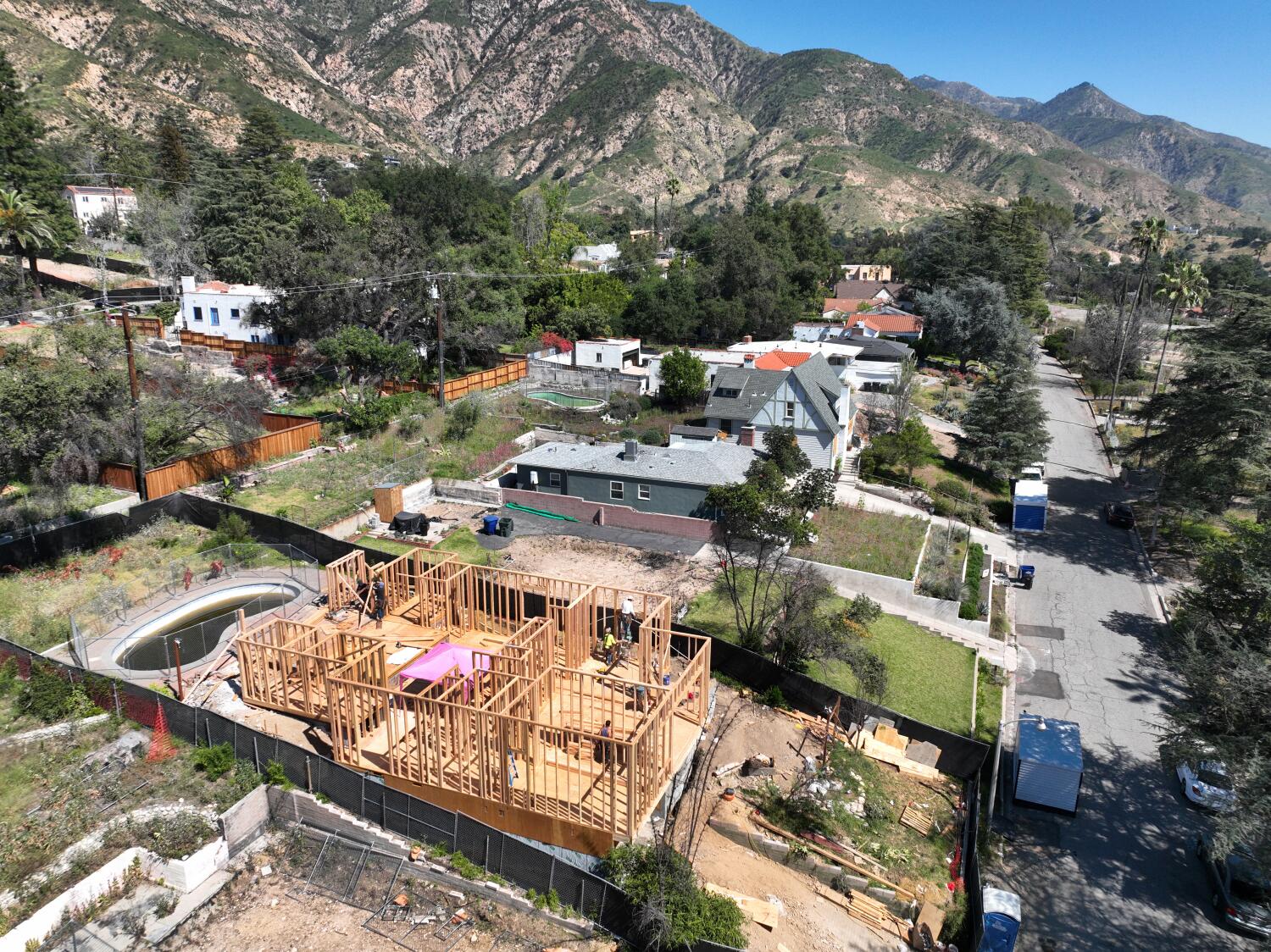
The surge in residential building permits across Altadena is a statistical illusion that masks a deepening housing gridlock. While local planning departments report a significant uptick in approved applications, the actual conversion rate from paper to physical structures has hit a decade-long floor. Homeowners and developers are securing the right to build, but they are finding it nearly impossible to break ground as a toxic mix of predatory lending rates, a shrinking pool of skilled labor, and an archaic local regulatory framework creates a bottleneck that no amount of bureaucratic green-lighting can fix.
The numbers look good on a spreadsheet. On the streets, it is a different story.
Altadena occupies a unique, often precarious position in the Southern California real estate market. As an unincorporated community, it lacks the municipal autonomy of Pasadena but remains subject to the sweeping, often heavy-handed mandates of Los Angeles County. This creates a double-layered barrier for anyone trying to add a second unit or remodel a vintage craftsman. The current permit "boom" is actually a backlog clearing event, not a sign of economic vitality. People who applied for permits two years ago are finally getting them, just as the financial math for those projects has turned upside down.
The Mirage of Growth
To understand why a permit is not a house, you have to look at the "drop-off" rate. In a healthy market, roughly 85 percent of issued residential permits result in a ribbon-cutting within eighteen months. In the current Altadena climate, that number has plummeted to below 45 percent. We are seeing a historic rise in "zombie permits"—legal authorizations that will likely expire before a single shovel touches the dirt.
The primary culprit is the cost of capital. Most Altadena projects are financed by mid-tier developers or individual homeowners utilizing bridge loans or construction-to-permanent financing. When these projects were envisioned in 2022 and early 2023, interest rates were manageable. Today, those same borrowers are staring at rates that have doubled, effectively vaporizing their margins. A project that made sense at 4 percent interest is a suicide mission at 8 percent.
Furthermore, the price of materials hasn't followed the cooling trend of the broader economy. While lumber prices have stabilized from their pandemic peaks, specialized components—electrical panels, HVAC systems, and copper piping—remain trapped in a supply chain that favors massive commercial builds over the small-scale residential work typical of Altadena’s foothills. The local contractor is no longer just competing with the guy down the street; he is competing with multi-billion dollar infrastructure projects for the same wire and the same workers.
The Labor Vacuum
You cannot build a house with a piece of paper. You need a plumber, an electrician, and a framer who knows how to handle the specific topographical challenges of the San Gabriel Mountains. Altadena’s aging housing stock requires a level of finesse that the modern "turnkey" construction industry has largely abandoned.
There is a massive generational exit happening in the trades. The veteran contractors who understood the nuances of Altadena’s granite-heavy soil and irregular lot lines are retiring. They are being replaced by larger firms that prioritize volume over custom solutions. These firms aren't interested in a $200,000 Accessory Dwelling Unit (ADU) or a complex kitchen expansion. They want five-hundred-unit complexes in the valley.
This leaves the Altadena homeowner in a desperate spot. They hold a valid permit but cannot find a reputable crew willing to take on a "small" job for a price that doesn't feel like a shakedown. The result is a surge in unpermitted, "handyman" level work that often fails inspection, further dragging out the timeline and increasing the eventual cost of the project. It is a cycle of failure that begins the moment the County stamps the blueprints.
The Regulatory Anchor
Los Angeles County’s Department of Regional Planning is often where good intentions go to die. While California state laws have theoretically made it easier to build ADUs, the local interpretation of these laws remains a labyrinth of frustration. In Altadena, specific zoning quirks—such as protected trees and historical preservation zones—add months, if not years, to the approval process.
By the time a homeowner navigates the "Oak Tree Ordinance" and the various hillside development permits, the original quote from their builder is long dead. Construction inflation moves at a pace that the County’s bureaucracy simply cannot match. A permit issued today is based on a reality that existed six months ago.
The Financial Cliff
We are entering a period of significant equity erosion. Many Altadena residents took out HELOCs (Home Equity Lines of Credit) to fund their improvements. As property values in some sectors of the unincorporated county begin to plateau or dip slightly due to decreased demand at high price points, the "equity cushion" that funded the permit boom is thinning.
Bankers are becoming skittish. A permit is an asset, but only if it results in an improved property value. Lenders are now performing more frequent "re-appraisals" during the construction phase. If they see that the cost of completion has risen beyond the projected value of the home, they can—and do—freeze the remaining draws on the loan. This leaves the homeowner with a half-finished shell of a building and a permit that is essentially a legal liability.
This isn't just a headache for the wealthy residents of the Upper West Side. It is a crisis for the working-class families in the central and southern parts of the community who were counting on ADUs to provide rental income or a place for aging parents. The "Permit Pick-up" touted by some as a win is, for many, the start of a financial nightmare.
The Hidden Cost of Sustainability
California’s aggressive new building codes, while environmentally noble, have added a "green tax" to every permit issued. The requirements for all-electric builds, solar readiness, and high-efficiency insulation have added between $30,000 and $60,000 to the baseline cost of a standard remodel.
In a community like Altadena, where many homes were built before 1950, upgrading a single system often triggers a mandatory upgrade of the entire structure to meet modern codes. This "Scope Creep" is the silent killer of projects. You start wanting to add a bedroom, and you end up having to rewire the entire house and replace the main water line just to satisfy the inspector. Many permit holders see these requirements and simply walk away, leaving the permit to expire and the housing stock to continue its slow decay.
The Infrastructure Gap
Even if the money and labor were available, Altadena’s physical infrastructure is screaming for help. The community relies on a patchwork of water companies and a power grid that struggles under the weight of modern demand. Adding "density" through ADUs is a fine policy on paper, but the reality of 1920s-era water mains and transformers doesn't always support the dream.
Public works projects in the area have lagged significantly behind the residential permit issuance. We are adding potential residents to a system that hasn't seen a significant upgrade in decades. This creates a hidden friction. A developer might get a permit to build, only to find out that the local water company requires a $15,000 "impact fee" or a system upgrade before they will allow a new meter. These "last mile" costs are rarely factored into initial budgets, and they are the final straw for many struggling projects.
A Systemic Failure
The current situation in Altadena is a microcosm of a larger California pathology. We have replaced actual building with the process of building. We celebrate the issuance of a permit because it is a measurable metric that makes politicians look productive. It suggests that the housing crisis is being addressed through administrative efficiency.
But a permit is not a roof. It is a promise that the state is currently making it impossible to keep. The focus on "picking up permits" ignores the reality of the "permit to completion" pipeline, which is currently clogged with debt, regulation, and a lack of skilled hands.
Moving forward requires more than just faster permit processing. It requires a radical reassessment of how we finance small-scale residential construction and a genuine investment in trade schools to replenish the dying workforce. Until the cost of building is decoupled from the volatile swings of the federal interest rate and the suffocating weight of county-level overreach, the paper boom in Altadena will remain just that—paper.
The most dangerous thing a homeowner can do right now is assume that an approved permit is the end of their struggle. In reality, it is often just the beginning of a long, expensive road to nowhere. The "permits are up" narrative is a comfort to those who don't have to pay the bills, but for the people of Altadena, the reality is a stalled landscape of unrealized potential and mounting debt.
Investors and residents alike must stop looking at the County’s "approved" pile and start looking at the "commenced" pile. That is where the truth lives. If you are holding a permit in this environment, your biggest challenge isn't the government; it's the math. And the math, for the foreseeable future, is not in your favor.