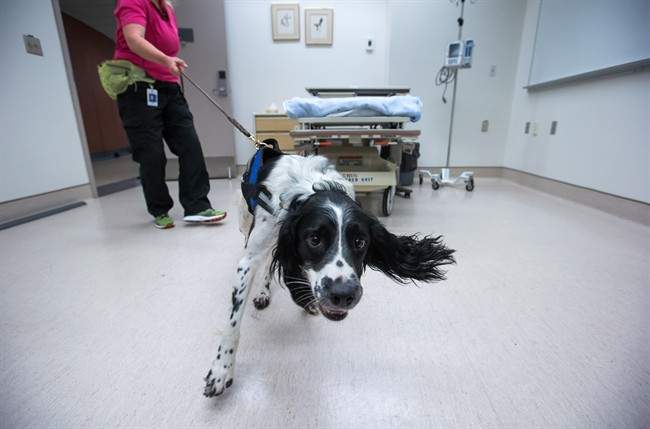
Angus is a Very Good Boy, but he is a terrible diagnostic strategy.
The retirement of the world’s most famous C. difficile sniffing Springer Spaniel has triggered the usual flood of sentimental fluff pieces. We love the narrative: a wagging tail saving lives where cold, sterile machines supposedly failed. It’s a heartwarming story that masks a cold, hard truth about the inefficiency of modern hospital management. Meanwhile, you can find other stories here: The Henrietta Lacks Settlement Myth and the End of Medical Altruism.
While the public celebrates a decade of "canine innovation," the reality is that relying on bio-detection dogs is a symptom of a healthcare system that has given up on scalable, data-driven hygiene. We are sentimentalizing a workaround because we are too lazy to fix the underlying infrastructure.
The Variable Variable: Why Biology Fails the Lab Test
The most dangerous thing in a clinical setting is an uncalibrated instrument. In a laboratory, if a PCR machine has a bad day, we throw it out or recalibrate it. When a dog has a bad day—because it’s humid, because it’s distracted by a ham sandwich in a visitor’s pocket, or because it simply feels off—we call it "animal nature." To explore the bigger picture, check out the detailed report by Psychology Today.
In the world of infection control, "animal nature" is another word for "unacceptable risk."
The peer-reviewed data often cited by canine advocates usually comes from controlled pilot studies. In those environments, dogs like Angus boast impressive sensitivity rates. But medicine doesn’t happen in a controlled pilot. It happens in chaotic, multi-drug resistant environments where the scent profile of a ward changes every hour.
C. difficile (Clostridioides difficile) isn't a static target. It’s a complex bacterial infection that produces volatile organic compounds (VOCs). A dog isn't "smelling a disease"; it is performing a high-speed pattern recognition task based on a shifting chemical cloud.
The problem? Humans are suckers for the Clever Hans Effect. We subconsciously cue the animal. When a handler knows which room is suspected of an outbreak, their body language shifts. The dog alerts. We cheer. We call it "medical intuition." A scientist calls it a compromised double-blind.
The True Cost of a Wagging Tail
Let's talk about the "cheap" alternative myth. Proponents argue that dogs are a cost-effective way to sweep hospitals. They are wrong.
To deploy a dog like Angus, you aren't just buying a bag of kibble. You are investing in:
- Specialized Training: Months of intensive scent work with high-level handlers.
- Housing and Liability: Dogs are living liabilities in a sterile environment.
- The Handler’s Salary: You aren't just paying for a dog; you’re paying for a highly trained specialist to walk that dog for 8 hours a day.
- Maintenance of "Accuracy": Continuous testing to ensure the dog hasn't lost the scent.
Compare this to the "Electronic Nose" or gas chromatography-mass spectrometry (GC-MS). While the upfront cost of a high-end VOC sensor is significant, its marginal cost per test is pennies. It doesn't need a nap. It doesn't get distracted by a cat in the parking lot. Most importantly, it provides quantitative data, not just a binary "bark or no bark."
We have spent a decade cooing over Angus while stalling the development of bedside VOC sensors that could have been integrated into every HVAC system in the country by now. We chose the mascot over the machine.
The False Security of the "Sweep"
The biggest failure of the canine model is the illusion of safety it provides. When a dog "clears" a ward, staff breathe a sigh of relief. This is a psychological trap.
C. difficile spores are notoriously resilient. They can live on a bed rail for months. If a dog doesn't pick up a scent because the spores are currently dormant or the concentration hasn't hit the threshold of that specific dog's nose that morning, the hospital treats the room as "clean."
This creates a "negative-sense" bias. Staff become less rigorous with manual disinfection protocols because "the dog didn't find anything." In reality, a dog's failure to alert is not proof of absence; it's merely a lack of evidence.
In my years consulting for hospital logistics, I've seen facilities cut corners on UVC disinfection robots because they spent the budget on a "bio-detection program." They traded a 99.9% kill rate for a 80% detection rate. That isn't healthcare; it's theater.
What People Also Ask (and the answers they hate)
Can dogs replace lab tests?
No. And anyone suggesting they can is bordering on malpractice. A dog's alert is a screening tool at best, yet it's often treated as a definitive signal to start isolation protocols. This leads to "isolation fatigue" among staff and unnecessary costs for the patient.
Are dogs faster than PCR?
Speed is irrelevant if the accuracy is inconsistent. A PCR test takes a few hours but gives a definitive genetic match. A dog gives you a "maybe" in seconds. If you have to run the PCR anyway to confirm the dog's alert, you haven't saved time; you've just added a middleman with fur.
Why don't more hospitals use them?
Because insurance companies and risk management departments hate them. They are impossible to standardize. You cannot write a universal Standard Operating Procedure (SOP) for a Golden Retriever's mood swings.
The Path Forward: Retire the Concept, Not Just the Dog
We need to stop looking for "natural" solutions to "industrial" problems.
The future of C. difficile detection isn't a better breed of dog. It’s the miniaturization of mass spectrometry. We should be investing in smart toilets that analyze waste in real-time and HVAC sensors that detect VOC spikes before a single patient shows symptoms.
Using a dog to find an outbreak is like using a smoke detector that only goes off when it feels like it. It’s charming in a 19th-century sort of way, but it has no place in a 21st-century ICU.
We shouldn't be looking for the "Next Angus." we should be looking for the sensor that renders the "Next Angus" obsolete.
The most "human" thing we can do for patients isn't bringing a dog into the ward; it's building a system so precise that the dog isn't necessary. Angus deserves his retirement. The program he represents should retire with him.
Stop hiring dogs to do a sensor's job.